

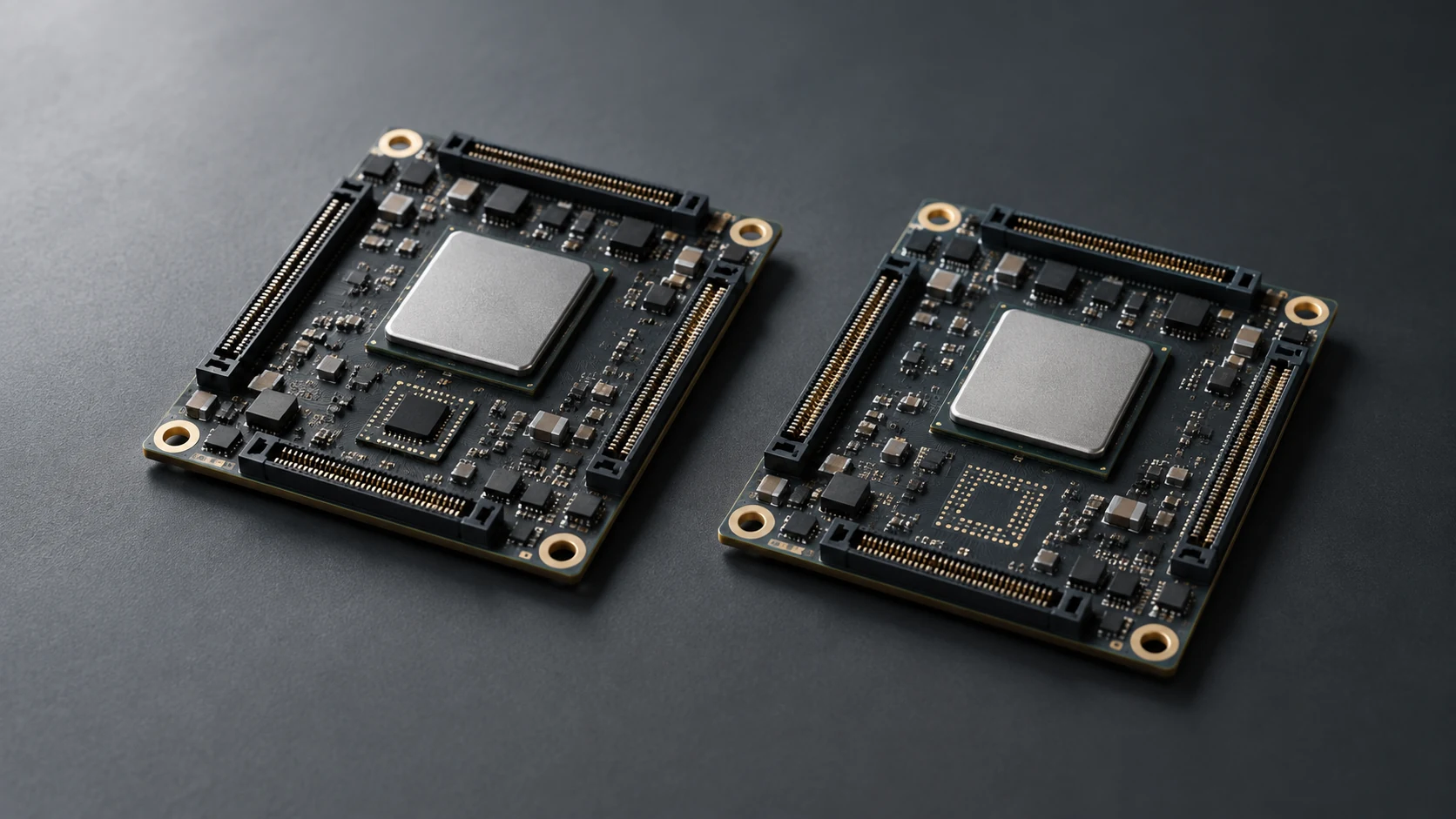
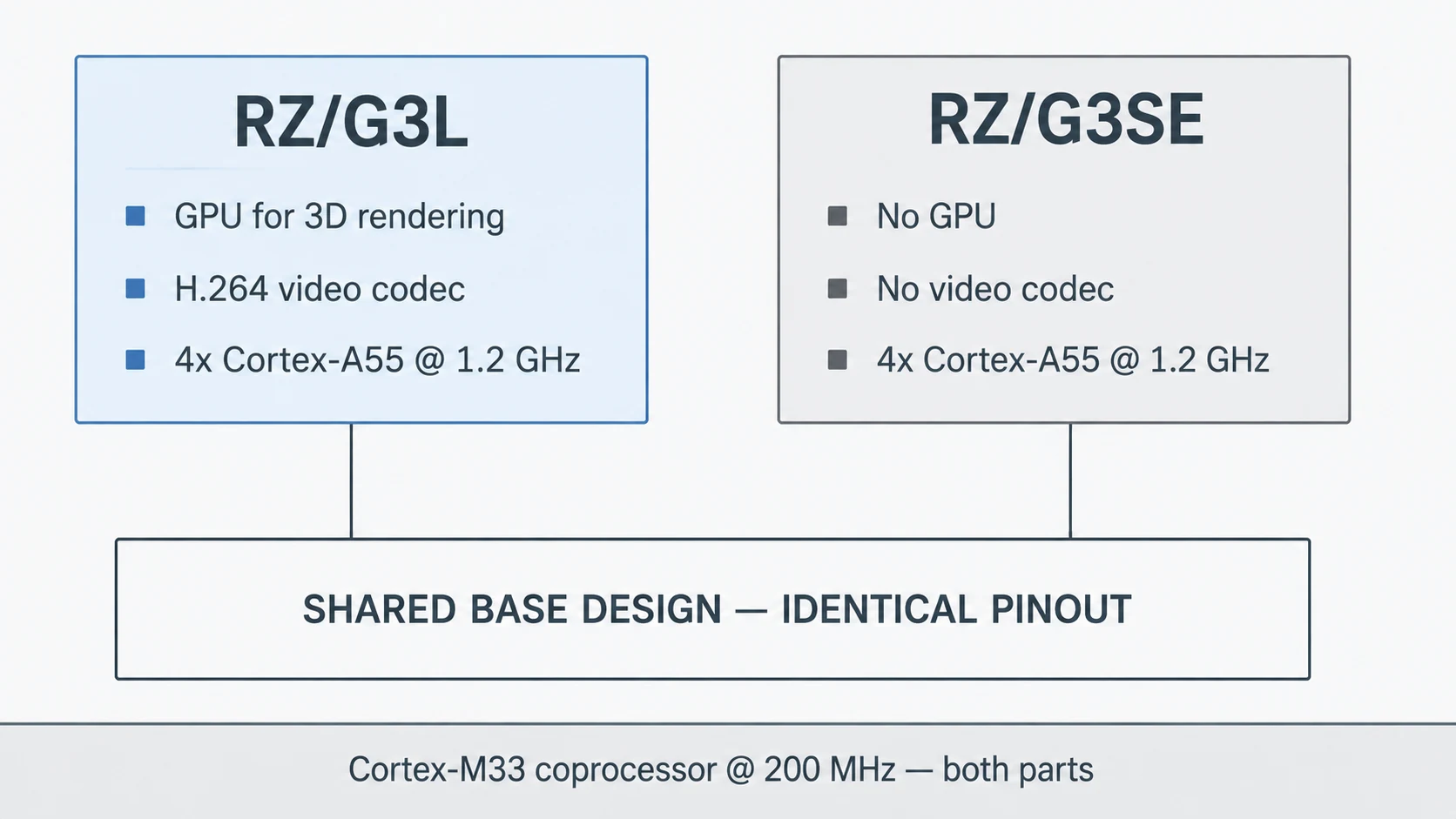
On September 10, Renesas added two 64-bit microprocessors to its RZ/G family: the RZ/G3L and the RZ/G3SE. Both target human-machine interface and IoT edge equipment. Both run up to four Arm Cortex-A55 cores at 1.2 GHz alongside a 200 MHz Cortex-M33 coprocessor. The difference between them is deliberate and narrow — the RZ/G3L integrates a GPU for 3D rendering and an H.264 video codec, while the RZ/G3SE leaves both out.
The specification that matters most, though, is not on either feature list. The two parts are pin-compatible.
One board, two product tiers
Pin compatibility means a single PCB design can carry either processor. For anyone who builds a range of touch-screen products rather than a single model, that changes the engineering arithmetic.
Consider what a typical panel PC catalogue actually contains. At the upper end sit units driving rich graphics — smart retail terminals, medical HMI equipment, anything where the display is doing real visual work. At the lower end sit units whose screen shows a status readout or a configuration menu, nothing more: EV chargers, industrial gateways, equipment controllers. Renesas has aimed the RZ/G3L at the former and the RZ/G3SE at the latter.
Under the conventional approach, those two tiers get separate mainboards, separate validation cycles, and separate bills of materials. Under a pin-compatible approach, they share a board and differ by which processor is populated. Renesas frames the benefit as reduced redesign work and simpler product-line development. In practice it also means one thermal design to qualify, one set of EMC test results to reference, and one spares inventory to carry.
Idle power becomes a specification
The second notable claim concerns power at rest. Renesas states that deep-standby consumption on the third-generation RZ/G architecture reaches the 1 mW level, and that the processors can hold the Linux system in memory while standing by, then resume quickly.
That combination — near-zero idle draw plus fast wake without a full boot — addresses a specific and common problem. A large share of industrial and commercial terminals spend most of their service life doing nothing. A kiosk in a lobby overnight. A gateway between polling intervals. A charger between sessions. Historically the options were to leave the system fully powered, burning energy for no work, or to power it down and accept a boot delay when someone finally walks up to it. Neither is satisfying when the equipment is expected to feel instant.
Interfaces that reflect where edge workloads are heading
Both parts carry PCIe, USB, and TSN-capable Gigabit Ethernet. Renesas notes PCIe can attach 5G or Wi-Fi 6 modules as well as external AI accelerators, and positions TSN for deterministic, low-latency industrial networking.
The PCIe-for-accelerators detail is worth pausing on. It reflects an assumption that local inference is becoming a normal requirement rather than a specialised one, and that the compute needed for it will not always be on the main SoC. Keeping an expansion path open is cheaper than over-provisioning silicon that most units in a product family will never use.
Long-life provisions
The security and lifecycle specifications read like a list written by people who have supported deployed equipment. ECC protection covers on-chip memory and external DDR. Secure Boot, Arm TrustZone, tamper detection, and Renesas Secure IP are all present. Operating temperature spans -40 °C to +125 °C. The Verified Linux Package is compliant with the Civil Infrastructure Platform, which exists specifically to provide long-term support for industrial systems.
Renesas is supporting the parts with Linux and Zephyr RTOS, GUI tooling, and third-party system-on-module offerings. The eeNews Europe reports name LVGL, Embedded Wizard, Slint, Qt Group, Zephyr, and Embedded Artists among ten ecosystem partners. Both processors are available now, with evaluation kits based on a SMARC v2.1 module and carrier board.
Why this matters beyond one vendor's launch
Yinestar builds industrial panel PCs, box PCs, Android all-in-ones, and POS touch systems — four families that overlap heavily in mechanical design and diverge mainly in compute and display requirements. The engineering discipline Renesas is selling here is one we recognise, because the alternative is expensive: every performance tier that demands its own mainboard multiplies validation effort, extends lead times, and complicates long-term support for customers who bought three years ago and need a compatible replacement now.
Silicon vendors designing explicitly for platform reuse makes that discipline easier to sustain. So does an idle-power figure low enough that always-on and energy-conscious stop being opposing requirements. Neither is a headline feature. Both show up in total cost of ownership, which is where industrial buyers actually make decisions.