


On January 6, from Austin, Texas, the Wi-Fi Alliance released a new certification for client devices that operate only in 20 MHz channels and want to use Wi-Fi CERTIFIED 7 features. The stated intent is to extend Wi-Fi 7 to a wider range of products in smart homes, industrial environments and healthcare settings, and to move Wi-Fi 7 adoption forward in the IoT market.
Read as a bandwidth story, this is a small announcement about narrow channels. Read as a procurement story, it removes a coupling that has shaped industrial endpoint design for years.
The coupling that just came apart
The Alliance is direct about the history: newer Wi-Fi generations have favoured wider channels to deliver their performance benefits, and those requirements often sidelined IoT devices that would otherwise have benefited from the latest Wi-Fi. Sensors, wearables, industrial endpoints and low-power clients are typically designed for 20 MHz operation only.
The practical consequence was that two unrelated decisions arrived as one. A designer who wanted the current generation's reliability behaviour also had to buy the radio complexity, antenna count and power budget that came with wide-channel support, regardless of whether the device would ever move enough data to need it. A designer who chose 20 MHz on technical merit accepted being a generation behind on features.
Those are now separate decisions. Under the new certification a 20 MHz-only client can selectively enable advanced Wi-Fi 7 features without straining its resources — a different proposition from being told to widen the channel first.
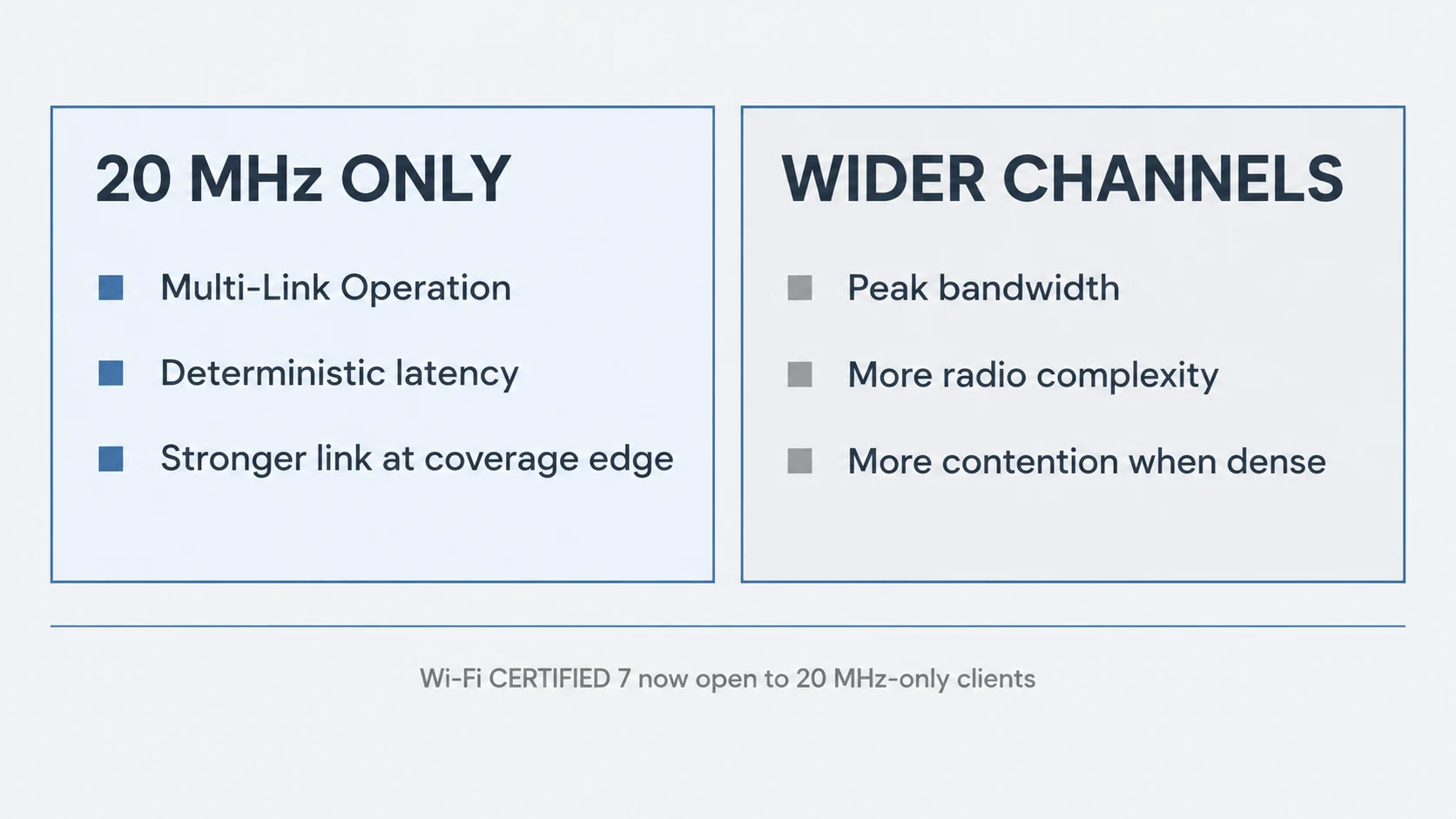
Which features survive the narrow channel
Three are named. Multi-Link Operation allows connectivity on multiple links at once, avoiding congestion dynamically, improving throughput and lowering latency, with one-shot association and switching between links for more reliable performance in dense environments. Downlink and uplink MU-MIMO lets multiple devices transmit upstream simultaneously without waiting for each other, giving true spatial separation in dense deployments. Multiple Resource Units combine non-contiguous sub-channels to make fuller use of available spectrum and improve coverage in places prone to interference or dead spots — the Alliance illustrates this with household appliances such as air purifiers, hair dryers and smart locks in large homes.
Notice what these three have in common. None of them is a throughput feature in the way a wider channel is a throughput feature. All three are about behaving predictably when the air is crowded and other radios are competing. That is the property a wall-mounted terminal on a production line needs, and it is the property a wider channel does not by itself provide.
Narrow is sometimes the better answer, not the cheaper one
The Alliance lists four benefits of 20 MHz-only operation, and two of them are physics rather than economics. Because signal energy is concentrated, 20 MHz channels tend to hold stronger, more robust links at the edge of coverage, which suits distributed sensors. And because narrow channels reduce interference, link reliability improves in crowded settings — the release names apartments, factories and enterprises together.
The other two are build-side. Narrower channels need less processing and less radio complexity, which extends runtime on battery-powered devices. Reduced RF design complexity also makes compact and low-cost devices easier to build.
For fixed equipment on mains power, the battery argument is irrelevant and the interference argument is decisive. A panel PC mounted on a machine, a kiosk in a terminal building, an all-in-one at a checkout — none is short of bandwidth. What they lack is a link that behaves the same at shift change as at 3 a.m., in a hall where dozens of access points and hundreds of clients share the spectrum. Wide channels there mean more overlap and more contention. The Alliance frames the factory floor alongside the smart home as a target for this certification, citing deterministic behaviour, scheduling efficiency and robustness in dense deployments.
What it changes about a bill of materials
The immediate effect is on module selection. A 20 MHz-only Wi-Fi 7 module can now carry a certification mark, which means a specification sheet can state a generation and a feature set without implying a channel width the device will never use. That is a smaller antenna problem, a smaller power problem and a smaller thermal problem than wide-channel Wi-Fi 7, at the same generation label.
Supply looks plausible rather than speculative. Alongside the certification the Alliance published statements of support from silicon vendors including Infineon Technologies, Silicon Labs, Synaptics and Texas Instruments, and from the Connectivity Standards Alliance and Plume on the smart-home side. Endorsements are not shipping parts, but the named companies are the ones who would build them.
How we read it
Yinestar builds industrial panel PCs, box PCs, Android all-in-ones and POS touch systems. Wireless is where we see the widest gap between what a datasheet promises and what a site delivers, and the gap is almost never about peak rate. It is about a terminal that reconnects slowly after an access-point handover, or drops a transaction at the busiest hour in the busiest part of the building.
Certification bodies removing a requirement is an unusual kind of progress: nothing new was invented, a barrier was withdrawn. But withdrawing it means the reliability work done in Wi-Fi 7 is now available to the class of device that most needed it and was least able to justify the radio. For anyone specifying fixed endpoints, that is the part worth acting on.