

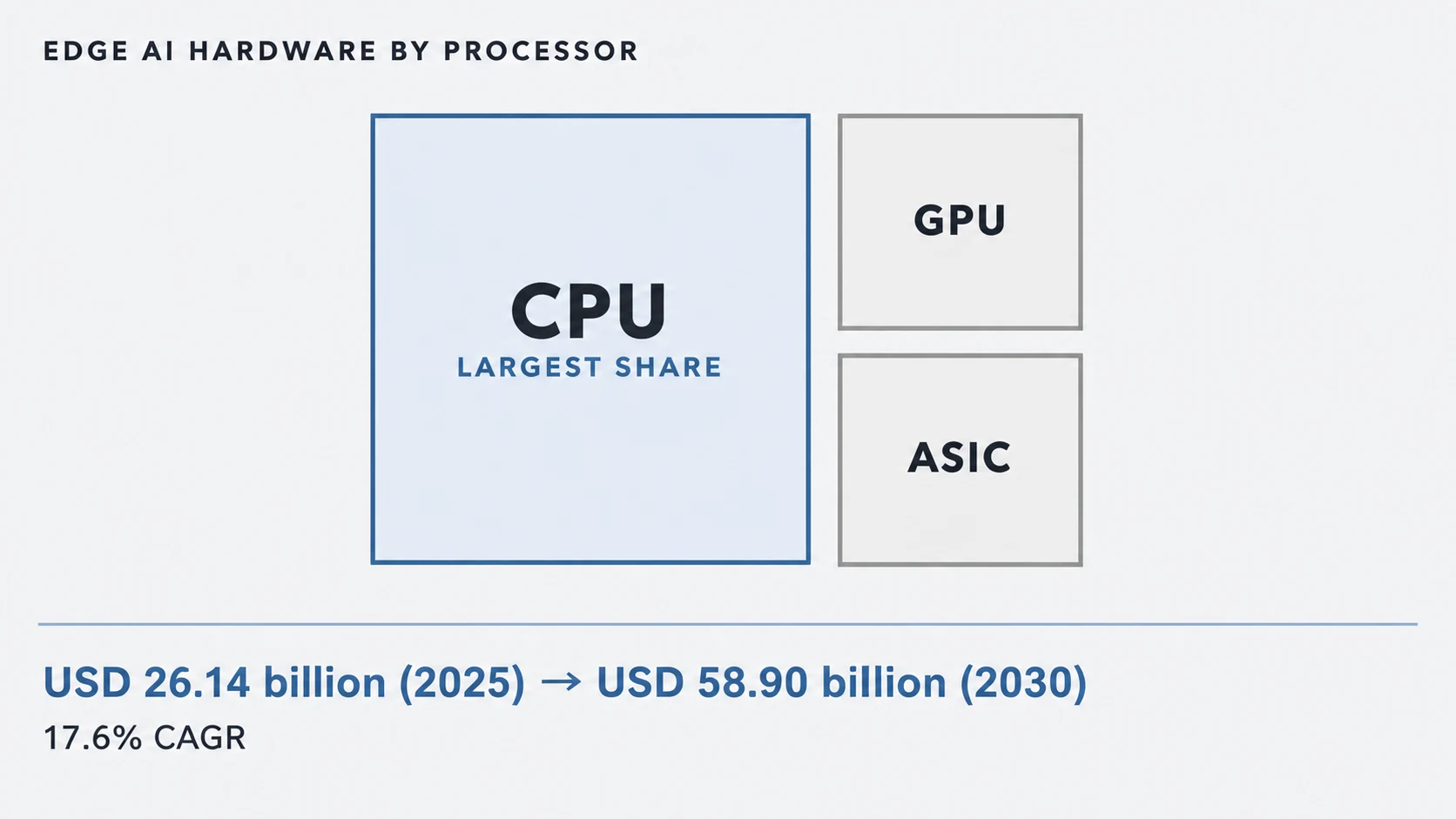
MarketsandMarkets projects the edge AI hardware market to reach USD 58.90 billion by 2030, from USD 26.14 billion in 2025 — a compound annual growth rate of 17.6%. Its stated driver is the spread of IoT devices across smart homes, industrial automation, healthcare and transportation, where applications need real-time processing so decisions happen locally rather than in the cloud, and where local processing also serves latency, privacy and data security.
The forecast total is not the interesting part. One segment finding contradicts what most coverage of edge AI implies.
The largest processor share belongs to the general-purpose part
By processor, MarketsandMarkets finds CPUs hold the largest share of the edge AI hardware market. Not GPUs, and not ASICs.
Its reasoning is about breadth rather than peak throughput. The report credits CPUs' versatility, scalability and general-purpose nature, describing them as able to process AI tasks in real time as required by smart factories, autonomous devices and industrial IoT applications, and as supporting a heterogeneous environment of edge applications from smartphones and wearables to advanced industrial systems. Its framing is explicit that CPUs are less specialised than the alternatives, and that this is the source of their position — even as GPUs and ASICs gain ground in specialised applications.
For anyone selecting compute for industrial equipment, that is more useful than a growth rate, because it describes how the market buys rather than how it is marketed to.
What this settles about product architecture
The dominant narrative around edge AI implies an accelerator: a discrete GPU, an inference module, an add-in card. Sometimes that is right. A high-frame-rate inspection line running several models concurrently needs dedicated silicon, and no amount of general-purpose optimism changes that.
But most inference work in industrial and commercial equipment is not that. It is a defect classifier on a single camera. A people-counting model in a retail terminal. Predictive maintenance on vibration data. Anomaly detection on a sensor stream. These workloads are real and valuable, and they run acceptably on the processor already in the system.
The difference is not academic — it is one board or two, one thermal design or a redesign, one power supply or a bigger one. An accelerator a workload does not need is not neutral: it occupies volume in an enclosure that was tight already, adds heat to a chassis that may be fanless, adds a driver stack to maintain across operating system updates, and adds a component whose availability must be tracked for the life of the product. Those costs are paid on every unit shipped, including the ones running a model that never needed it.
We design on the assumption that local inference is a normal requirement rather than a premium option, and that most of it should run on the main processor. This market data suggests that assumption is not contrarian; it is where the majority of the segment already sits.
Power draw is treated as a segmentation axis, not a footnote
Note how MarketsandMarkets structures this market. Alongside device, processor, function, vertical and region, it segments by power consumption — bands of less than 1 W, 1 to 3 W, above 3 to 5 W, above 5 to 10 W, and more than 10 W.
That a research firm splits the market this finely by power says something about how edge AI hardware gets specified. The bands map onto mechanical decisions rather than performance ones. A part in the low single-digit watts can be cooled by an enclosure. Above ten watts, the enclosure becomes a heatsink with a computer inside it, and the industrial design changes accordingly. Choosing a band is choosing a chassis. The report also identifies improvements in hardware architectures — energy-efficient designs and industry-specific solutions — as having significantly influenced market growth, which is consistent with power being a primary axis rather than a derived specification.
Devices and regions
By device, MarketsandMarkets expects robots to record the second-highest CAGR over the forecast period, connecting this to robotics increasingly combining AI with edge computing so local processing supports split-second decisions without dependence on cloud infrastructure — relevant, it notes, to autonomous vehicles, industrial automation and healthcare robotics, where milliseconds affect safety.
Regionally, it places Asia Pacific as holding the largest share, attributing this to IoT adoption and AI investment across China, Japan, South Korea and India, a large consumer electronics base requiring efficient AI processing at the edge, deployment into smart homes, smart factories, healthcare and autonomous vehicles, plus government initiatives and collaborations with global technology firms.
The practical reading
Yinestar builds industrial panel PCs, box PCs, Android all-in-ones and POS touch systems. Across all four, the recurring customer question has shifted from whether local inference is possible to how much of it a platform can carry without becoming a different product.
This forecast offers a reasonable answer. If CPUs hold the largest share of edge AI processors on the strength of versatility rather than peak performance, the design target for general-purpose industrial computing is not to match accelerator throughput. It is to leave enough compute and thermal headroom that common inference workloads run on the standard configuration, and to keep an expansion path for deployments that genuinely need dedicated silicon. On this projection the market more than doubles between 2025 and 2030. Most of that volume will not be exotic hardware. It will be ordinary equipment running models on the processor it already had.