


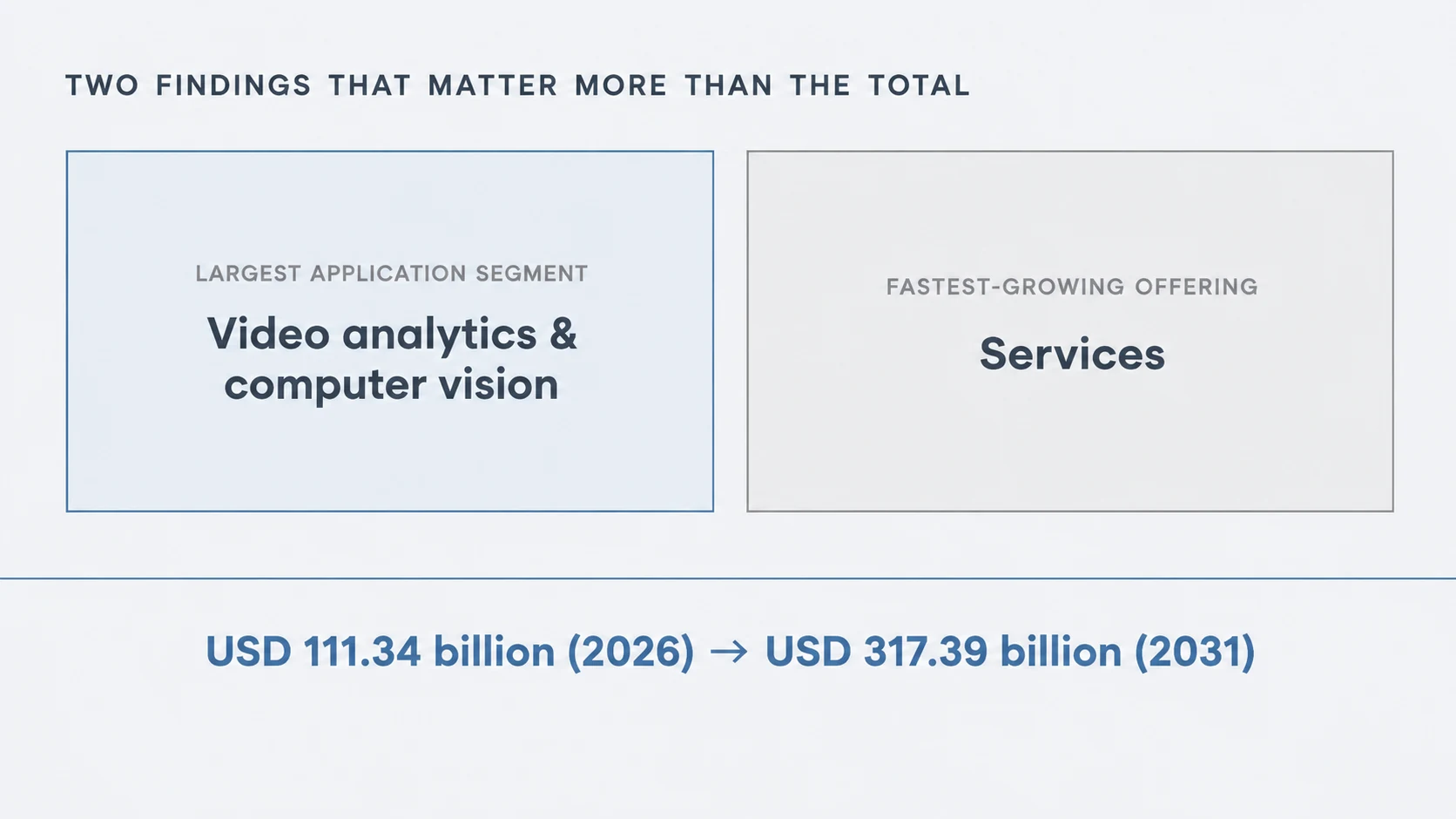
MarketsandMarkets forecasts the global edge computing market rising from USD 111.34 billion in 2026 to USD 317.39 billion by 2031, a compound annual growth rate of 23.3%. Aggregate figures at that scale are hard to act on. Two of the segment findings are not.
By application, video analytics and computer vision is expected to hold the largest market share across the forecast period. By offering, services is projected to grow at the fastest rate. Neither is a surprise alone. Placed side by side, they describe a real deployment problem.
The dominant edge workload is a camera
MarketsandMarkets defines the video analytics and computer vision segment as covering object detection, facial recognition, surveillance analytics, quality inspection and real-time visual intelligence across distributed environments. Its assessment is that enterprises in manufacturing, retail, transportation, smart cities, healthcare and public safety are increasingly deploying edge computing to process high-volume video closer to the source — enabling faster inference, cutting bandwidth consumption, reducing cloud dependency and improving response time. It credits three factors for the segment's lead: rapid expansion of AI-enabled cameras, increasing use of machine vision in industrial automation, and rising investment in smart surveillance infrastructure.
That the largest edge application is vision has direct consequences for hardware selection, because video is the least forgiving common workload at the edge. It arrives continuously rather than in bursts, leaving no idle period to catch up in. It scales with camera count, and camera count grows after installation. It needs decode capacity before any inference happens. And the useful output is often a small event — a defect flagged, a person counted — pulled from a stream vastly larger than the result.
Sizing a node for that differs from sizing one for asset monitoring or IoT telemetry. Under-provision the decode path and frames drop silently: the system keeps running and quietly stops seeing things. We would rather over-specify interface count and thermal headroom than find the ceiling after a customer adds the cameras that made the project worth doing.
Why the fastest-growing segment is not hardware
MarketsandMarkets attributes the services segment's growth to enterprises increasingly requiring specialised support to plan, deploy, integrate, manage and secure distributed edge environments — consulting, architecture design, deployment, integration, support, managed infrastructure operations, managed security and managed platform services. Its explanation is that as edge deployments expand across factories, telecom sites, retail stores, hospitals, transport networks and energy facilities, organisations need external expertise for complex workloads, remote monitoring, lifecycle management and security compliance.
Strip out the market framing and that is a finding about difficulty. Services grow fastest where buyers discover the hard part was not the purchase — a fleet spread across sites turns out to be a different problem from the pilot that justified it.
What actually gets hard between ten nodes and a thousand
The operational load MarketsandMarkets points to is where deployments stall. Remote monitoring means knowing a unit on a warehouse mezzanine is still processing, not merely still powered — and vision workloads fail in ways that look like health. Lifecycle management means every node running a known software state, with a way to move it forward that does not require a site visit. Security compliance means patching the fleet on a schedule someone else set, across sites with different network policies and different people holding the keys.
None of that is exotic, and all of it has to exist somewhere. The report's finding is that a growing share is handed to outside specialists. For a hardware manufacturer that is a signal: a platform with no coherent story for remote health, staged updates and documented configuration is exporting cost to whoever integrates it. That cost surfaces in the services line item, and eventually in the comparison against a platform that made it smaller.
Where deployment is concentrated today
MarketsandMarkets expects North America to be the largest regional market, citing advanced digital infrastructure, widespread 5G availability, mature telecommunications networks and strong cloud ecosystems, with enterprises there using edge processing to meet strict regulatory requirements alongside real-time insight across manufacturing, healthcare and logistics.
The report also points to two vendor moves from May and June 2025: HPE launching enhanced Edgeline converged edge systems for AI and analytics, and Cisco expanding its IoT Operations Dashboard for centralised management. Both predate this forecast's 2026 baseline, so they are context for how the segment developed rather than current news. Note what the second one is: a management plane. When the named examples of edge progress include a centralised dashboard rather than only faster hardware, the operational reading of this market is visible in the examples themselves.
How we read this from the hardware side
Yinestar builds industrial panel PCs, box PCs, Android all-in-ones and POS touch systems, and vision workloads land on the box PC and panel PC families most often — inspection stations, retail analytics, access points, transport terminals.
The takeaway here is not the 23.3% growth rate. It is the pairing of a vision-dominated application mix with services as the fastest-growing spend: the demanding workload and the demanding operations arrive together. A node specified only against the day-one camera count, with no provision for how it will be watched, updated and audited three years later, meets its specification and still costs its owner more than the alternative. That second half is less visible than benchmark numbers, and it is where distributed deployments are won or lost.