

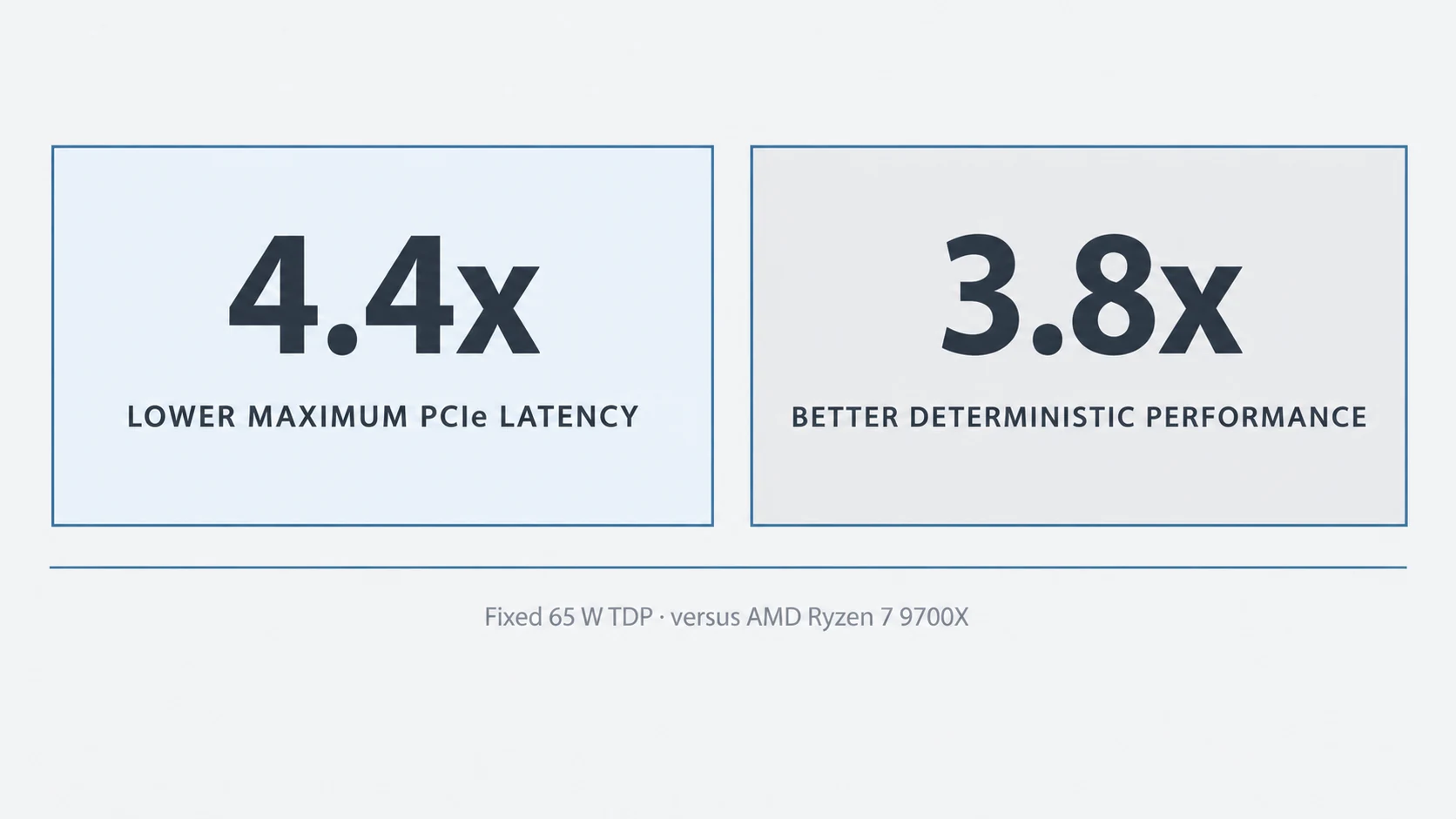
On March 9, at Embedded World in Nuremberg, Intel launched the Intel Core processor Series 2 with P-cores, positioning it as an industrial-ready platform for mission-critical edge applications. The same announcement previewed a sixth Edge AI suite, this one for health and life sciences. The processor came with four comparative figures against AMD's Ryzen 7 9700X: up to 4.4x lower maximum PCIe latency, up to 2.5x more deterministic response time, up to 3.8x better deterministic performance, and up to 1.5x higher multi-thread performance.
Those four numbers are the news. The disclaimers printed underneath them are the part worth reading twice.
What the footnotes actually specify
Intel attributes the first three figures to a single processor: an Intel Core 9 processor 273PE running at TDP = 65 W, measured against an AMD Ryzen 7 9700X also at 65 W. The PCIe figure is maximum PCIe read latency. The deterministic-response figure is maximum latency on a cyclic test. The deterministic-performance figure is maximum jitter on an RTC testbench. Intel presents all of them as estimates and notes that individual system results vary because power and performance are affected by use, configuration and other factors.
The fourth figure is a different comparison altogether. The multi-thread claim rests on SPECrate2017_int_base (n copy) estimates for an Intel Core 9 processor 273PQE at TDP = 125 W against an Intel Core i9-14901E at 65 W. It is not measured against the AMD part, it uses a different SKU from the first three, and it sits at nearly twice the power envelope.
None of that makes the numbers wrong. It does mean the four figures are not a single coherent comparison, and that three of them describe one part inside one power budget.
A power envelope is an enclosure specification
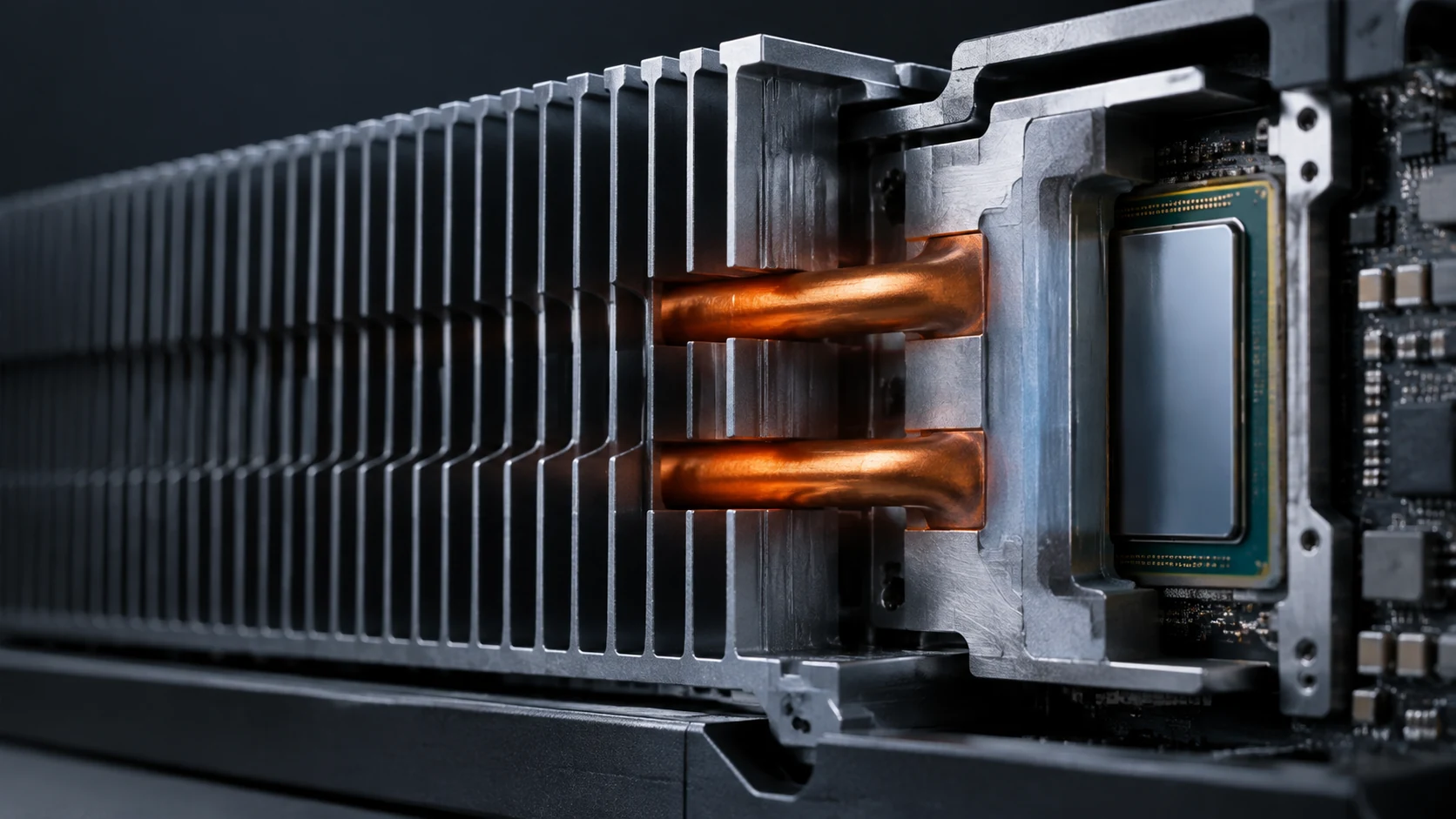
TDP = 65 W is a statement about heat that has to leave the machine. For anyone building the machine, that is the whole question. A box PC bolted inside a control cabinet at 45 °C ambient, a fanless unit sealed against dust, a wall-mounted terminal with no clearance behind it — each has a different answer to whether 65 W can be dissipated continuously rather than in bursts.
This matters more for determinism figures than for throughput figures, because of how they are measured. Maximum latency and maximum jitter are worst-case values. A benchmark that averages throughput absorbs a brief thermal excursion; a measurement that records the single longest delay does not. One clock-drop under sustained load moves the number the specification is built on. The deterministic behaviour a customer was sold is therefore a property of the thermal path, the sustained power delivery and the firmware configuration — none of which live on the processor die.
The test names describe a different question than "how fast"
A cyclic test and jitter on a real-time testbench measure how late a periodic task can be. They do not measure how much work gets done. That changes what a buyer should ask for: not peak performance, but the worst observed lateness under sustained load, in this enclosure, at the ambient temperature the equipment will actually see.
Intel's own framing points the same way. It describes conventional processors as forcing a choice between computational power and real-time reliability, pushing designers toward multi-processor architectures that add cost and complexity, and positions Core Series 2 as removing that trade-off. Consolidation is a real benefit, and it relocates risk: when one part carries both the timing-critical control loop and the general compute that used to sit elsewhere, the thermal and power design guarantees both. The failure mode of an under-specified chassis is no longer a slow machine, it is a machine that misses a deadline occasionally.
The healthcare suite is an argument about evaluation
The Edge AI suite for Health & Life Sciences, previewed at the show, provides validated reference pipelines and benchmarking tools for AI-enabled patient monitoring. It showcases concurrent, multimodal workloads running locally on Intel processors: AI-based ECG arrhythmia detection, remote photoplethysmography, and anonymous 3D visual tracking. Its stated purpose is to let OEMs, ODMs and independent software vendors evaluate platforms using representative scenarios rather than synthetic benchmarks. A preview is on GitHub, with general availability planned for Q2 2026.
There is a tension between the two halves of the announcement that we find useful rather than embarrassing. The same release that publishes single-number comparisons also argues that synthetic benchmarks are the wrong basis for platform selection. The second position is the more honest one, and it is the one that matches how terminals behave in service — several workloads at once, indefinitely, in a fixed installation.
How we read it
Determinism arriving as a headline number is a gain. It gives industrial buyers a vocabulary for something they have always wanted and rarely had a way to ask for. But the number belongs to a system, and the parts of that system a hardware builder controls are precisely the parts that decide whether it survives deployment.
Yinestar builds box PCs, industrial panel PCs, Android all-in-ones and POS touch systems. Across all four, the request that keeps coming back is not more peak performance; it is behaviour that stays the same in year three as in week one. Edge systems on Core Series 2 with P-cores and on the recently launched Core Ultra Series 3 are available now. Whether a given design realises the figures on the slide is answered by the chassis, not the part number.