

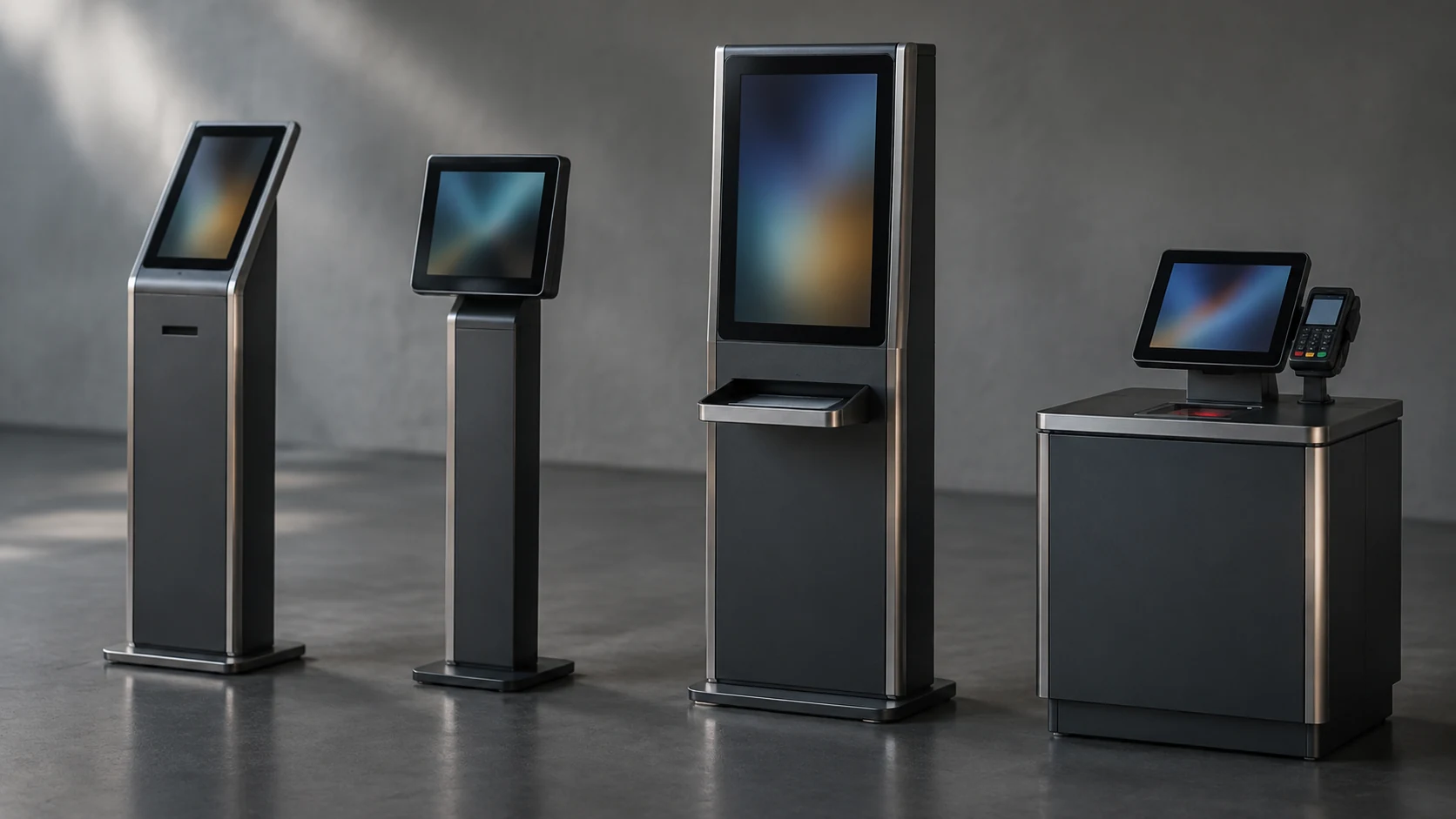
On June 18, SNS Insider published a forecast for the global interactive kiosk market, sized at USD 37.57 billion in 2025 and projected to reach USD 81.49 billion by 2035, a CAGR of 8.05% over 2026–2035. The research firm attributes the growth to broader adoption of self-service technology, on the grounds that it improves operational efficiency, shortens waiting times, and reduces operating costs.
Headline totals from market studies are of limited use to the people who actually build the equipment. The segmentation underneath is where the engineering consequences sit, and two of those breakdowns are worth separating out.
Almost 60% of the money is in the physical unit
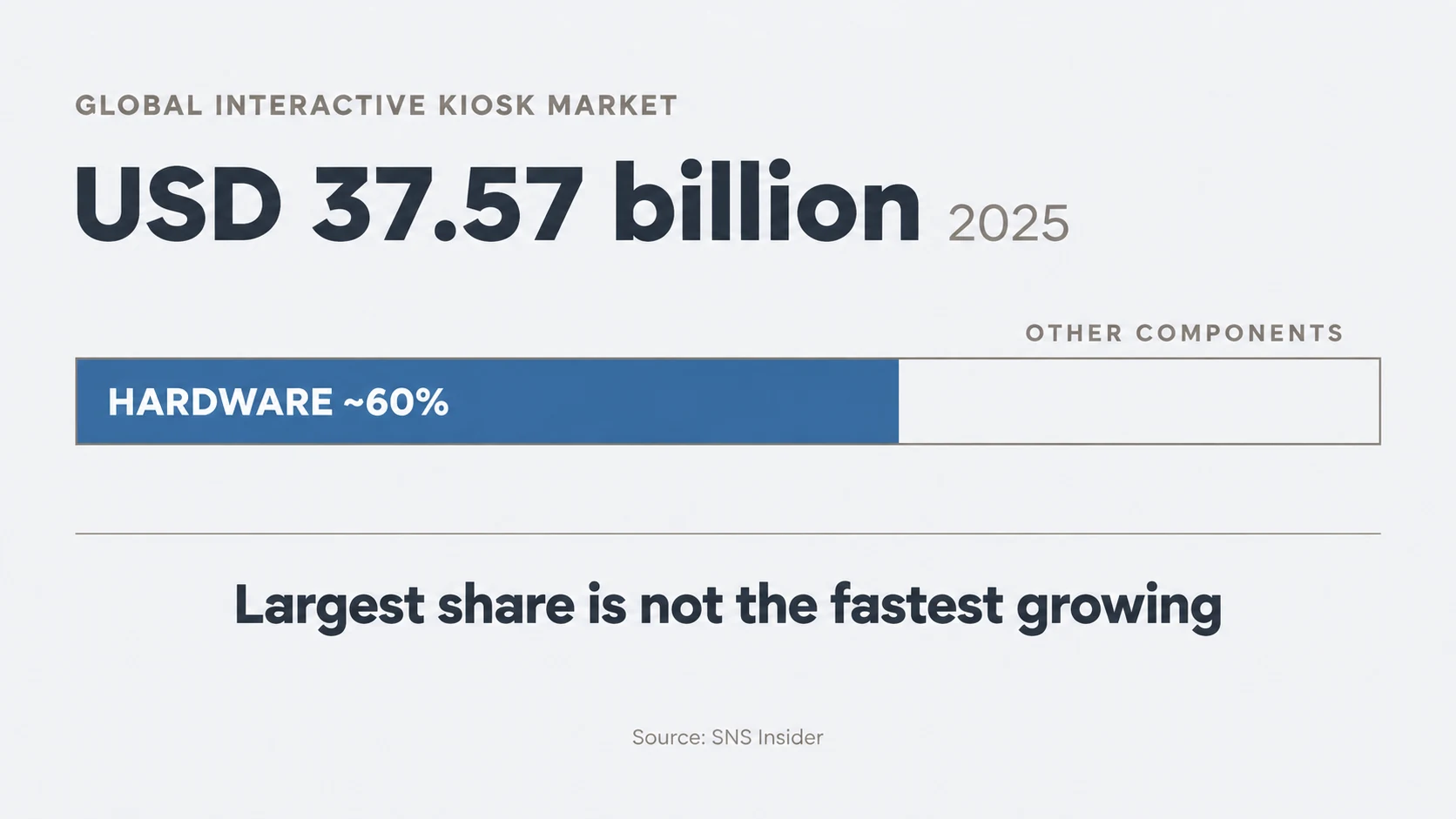
SNS Insider puts hardware at almost 60 percent of the 2025 market by component, and attributes that share to the substantial capital cost of touch-screen displays, printers, scanners, payment devices, and related equipment.
In a market discussed mostly in terms of AI, cloud management and contactless experience, that figure is a reminder of where the spend lands. The interaction a customer remembers is the interface. The invoice is mostly for a metal enclosure, a display stack, a set of certified peripherals, and the power and thermal design that keeps them running unattended.
SNS Insider also expects software to be the fastest-growing component category, driven by kiosk management software, cloud-based monitoring, and AI tooling. That is a growth-rate statement, not a displacement one. On the firm's own numbers hardware remains the majority of the market throughout, and software growth arrives as an additional requirement on the hardware rather than a substitute for it.
Remote management is a hardware specification
The recent developments SNS Insider cites make the dependency concrete. Both are dated 2025: NCR Corporation expanded its interactive kiosk portfolio with AI-powered self-service and contactless capabilities across retail, healthcare, hospitality and banking, and Diebold Nixdorf introduced intelligent kiosks integrating IoT connectivity and cloud-based management for operational visibility, predictive maintenance and personalised services.
Predictive maintenance is the item that reaches back into the mechanical design. Software can only predict a failure it can observe, which means the hardware has to report temperatures, fan behaviour, storage health, peripheral status, and door or tamper events. None of that is a software feature. It is decided when the mainboard, sensors and wiring are specified, and retrofitting it into a deployed fleet is rarely economic.
The largest segments are not the fastest-growing ones
The rest of the SNS Insider segmentation splits along an axis that matters for product planning.
By type, self-service kiosks held around 55% share in 2025 — the firm cites use across retail outlets, fast-food chains, banks and customer support centres — while ticketing kiosks are expected to post the highest CAGR through the forecast period. By application, retail led with around 50% of the 2025 market on the strength of self-checkout, product information kiosks, loyalty integration and customer service portals, while healthcare is expected to grow fastest, driven by patient check-in stations. By end user, BFSI held nearly 45% in 2025 through self-service banking, with government and the public sector projected to grow fastest on smart-city programmes, citizen-service digitisation, transport infrastructure and public information systems.
Read together, today's volume sits in retail and banking while the acceleration sits in ticketing, healthcare and public services. Those are not interchangeable duty cycles. A retail checkout terminal lives indoors under staff supervision. A transport ticketing unit may face semi-outdoor temperatures, vandalism, and no attendant at all. A patient check-in station shares a room with medical equipment and its own hygiene and accessibility expectations. Same category in a market report, materially different enclosure, ingress rating, display brightness and peripheral mix.
Regional share, and what it implies about variants
North America was the largest region in 2025 at approximately 38% of global revenues, which SNS Insider attributes to digital infrastructure, early self-service adoption, and the presence of leading kiosk manufacturers. Asia Pacific is expected to grow fastest, on urbanisation, rising consumer spending, and retail and healthcare expansion across China, India, Japan and Southeast Asia.
For a supplier the practical reading is that the two fastest-moving pieces of the market — new verticals and new regions — both arrive as demand for variants rather than volume on an existing configuration. Payment certification, language and accessibility requirements, and mains and safety standards differ by market, and they change the unit without changing what it does.
Why the component split is the number we watch
We build POS touch systems, industrial panel PCs, box PCs, and Android all-in-ones, and the four families are deliberately close in mechanical and thermal design. A forecast where hardware holds the majority of spend while growth concentrates in new verticals and new geographies is a forecast that rewards platform reuse and punishes one-off designs.
The AI and cloud layers get the attention, and on SNS Insider's own numbers they are growing faster. The unglamorous conclusion is that almost 60% of the market still turns on whether a physical unit survives its environment and can be serviced in place — and that share is being asked to cover a wider range of environments than the retail counter it was mostly built for.