

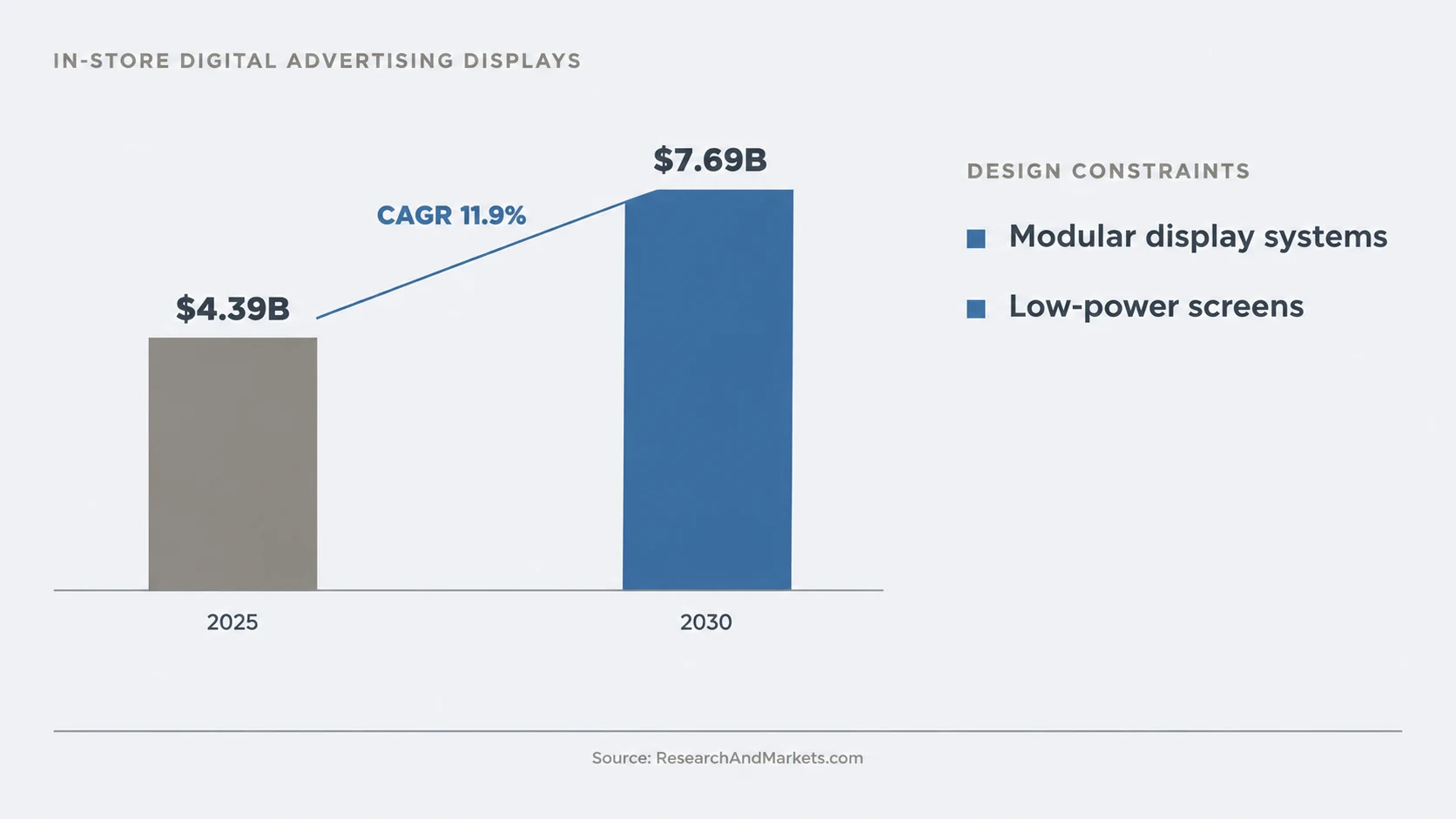
On July 17, ResearchAndMarkets.com published a forecast putting the global in-store digital advertising display market at $4.39 billion in 2025, $4.90 billion in 2026, and $7.69 billion by 2030, a CAGR of 11.9% over the forecast period. The firm credits retail media, digital signage technology, and personalised customer engagement for the growth.
The demand-side story is familiar by now: retailers are selling advertising inventory inside their own stores, and screens are the inventory. Less familiar is what that business model does to the specification of the screens themselves. Two constraints in the same forecast are worth pulling out, because both are decided at design time and neither can be added later.
Modular, because one chain is several store formats
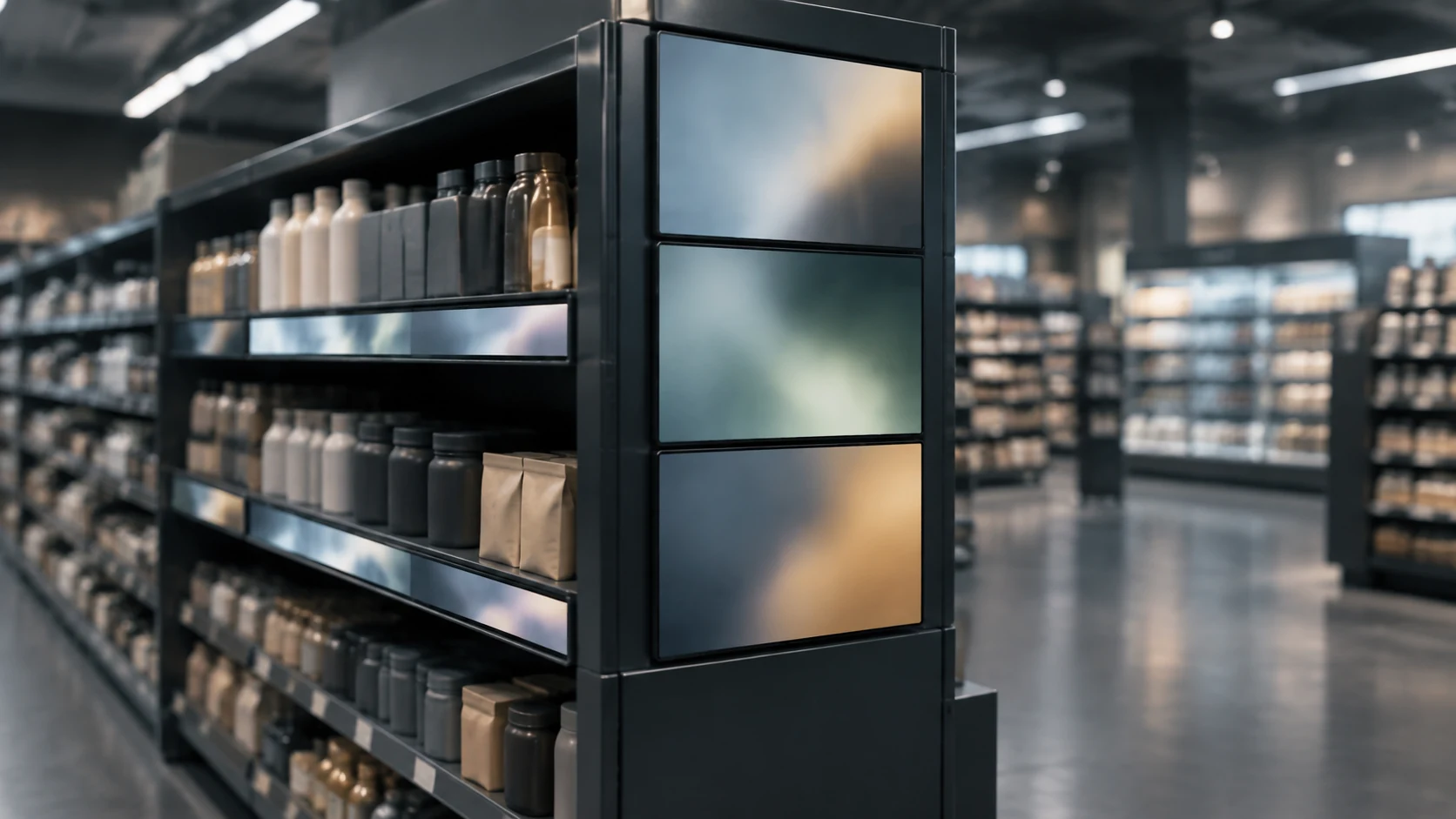
ResearchAndMarkets.com reports that modular display systems are gaining traction among retailers needing scalable infrastructure across supermarkets, convenience stores, restaurants, shopping centres, and other multi-format environments.
That single sentence describes a real procurement problem. A retail group running all of those formats has one media network, one content platform, and one advertising sales operation — and five very different physical sites. A supermarket endcap, a convenience-store counter, a restaurant menu wall, and a mall concourse have almost nothing in common in terms of viewing distance, ambient light, available depth, mounting surface, or who is standing in front of the screen.
Buying a separate purpose-built product for each format multiplies the integration work: separate mounts, separate power provisioning, separate spares, separate commissioning procedures for staff who are not installers. Modularity is the alternative — a common compute and connectivity core carried across display sizes and mechanical formats, so the network expands without the platform fragmenting. The forecast's own hardware categories name the boundaries along which such a family gets divided: display screens, mounting systems, media players, touch panels, connectivity modules, power supply units, enclosures, and sensors.
Low power, because the screen never turns off
The second constraint comes from the operating side. The report notes that technology providers are focusing on low-power display solutions that reduce operating costs and support remote content updates, and cites Samsung Electronics launching Color E-Paper displays for business applications in January 2026, aimed at retail and commercial environments. Those displays are positioned as combining high visibility with centralised content management, letting businesses replace printed promotional material while consuming less energy than traditional LCD signage.
Colour e-paper is a narrow tool — it suits static or infrequently updated content, not video or touch interaction. The reason it appears in a retail media forecast at all is instructive: energy has become a line item in the business case. A store might run dozens of screens for every hour it is open, and in some formats longer. Consumption that is negligible per unit stops being negligible per chain, and it also sets the power provisioning at each site, which is often the single most expensive part of adding a screen where none existed.
For a manufacturer that pushes power management out of the datasheet and into the requirement list: idle draw when no one is present, brightness scheduling tied to store hours, and thermal design that avoids fans in a customer-facing enclosure.
Where interaction still earns its cost
Not every screen needs to be touched. The forecast lists interactive touch-screen kiosks and digital menu boards alongside passive signage, shelf-edge displays, and video walls, and it expects continued quick-service restaurant expansion to create significant opportunity — digital menu boards, self-service kiosks, and promotional screens supporting rapid menu updates, better order efficiency, and additional upselling. It puts Canada at 21,243 fast-food restaurants in 2025, up 3% from 2024, citing Made in CA.
Quick-service restaurants are the case where advertising surface and transaction surface are the same object. That distinction decides whether a unit needs a certified payment path, a receipt printer, and the certification maintenance that comes with them — or whether it is a screen showing scheduled content and nothing more.
Regional and market framing
North America was the largest regional market in 2025, attributed to mature retail infrastructure and strong adoption of digital signage and retail media technologies. Asia-Pacific is expected to grow fastest through 2030 as retailers modernise stores and invest in digital customer experience. The report describes the market's history as a shift away from static promotional boards and printed advertising toward LCD signage and centralised content management, and expects future growth from AI-powered advertising, programmatic retail media networks, interactive displays, and omnichannel engagement.
Two named trends — dynamic content scheduling based on footfall patterns, and loyalty programme integration — assume the screen knows something about its surroundings. That again lands on sensors and connectivity specified at build time.
What we take from it
Yinestar builds Android all-in-ones and POS touch systems alongside industrial panel PCs and box PCs, and the retail media buildout touches all four. The part of this forecast we find most usable is not the 11.9% CAGR. It is that two of the trends named in it — modular systems across mixed formats, and energy-efficient signage — are hardware architecture decisions being driven by an advertising business model.
That is an unusual chain of causation, and it favours suppliers whose product families were designed for reuse rather than assembled per project. A media network that grows one store format at a time cannot afford a new platform for each of them.