

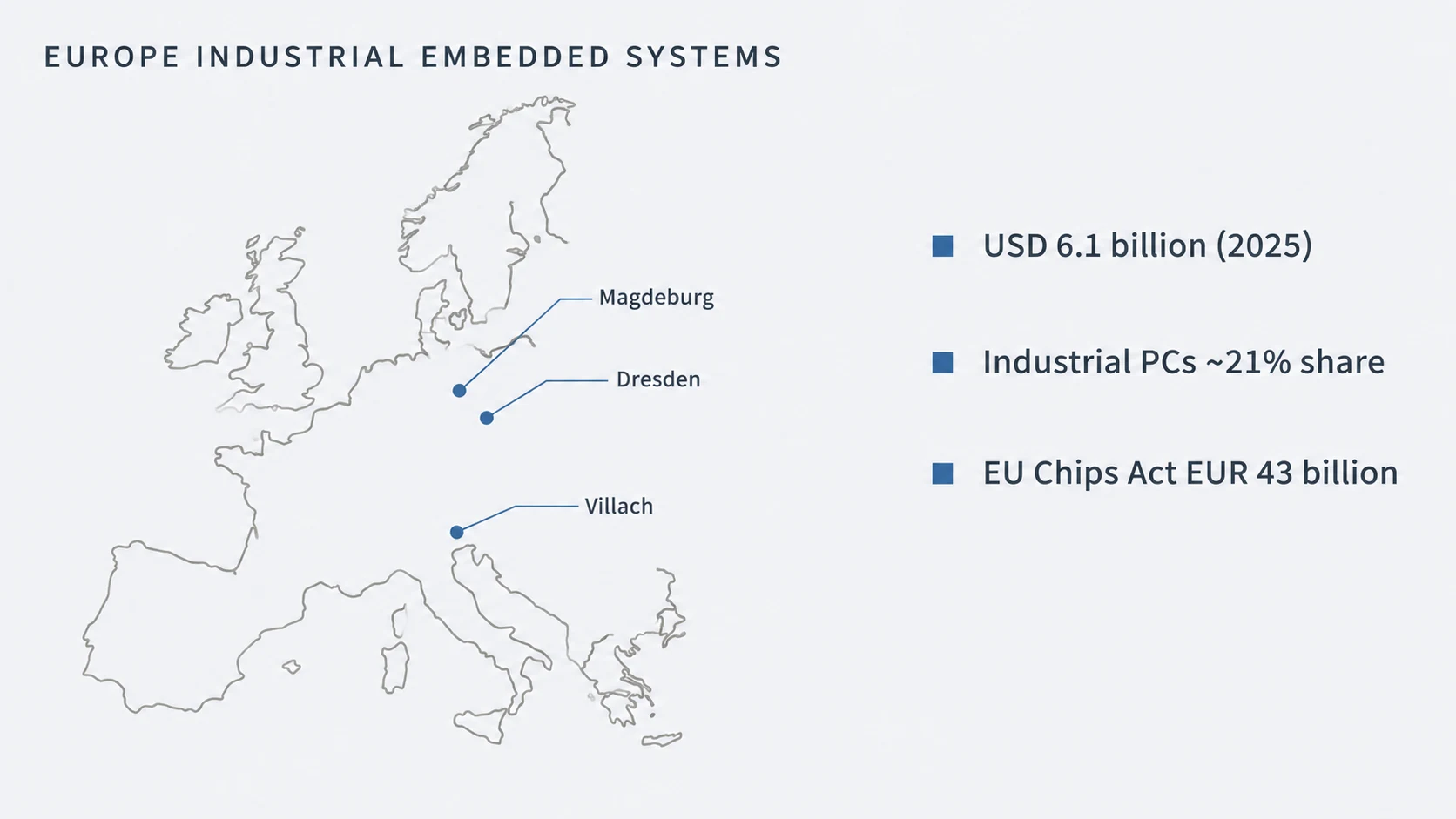
On September 14, Research and Markets published a forecast for Europe's industrial embedded systems market: USD 6.1 billion in 2025, rising to USD 9.4 billion by 2035, at a compound annual growth rate of approximately 5.7% from 2026 to 2035. Germany led the region in 2025 with roughly 27% of revenue.
Inside that report is a number that matters more to anyone building this equipment than the market total does. Industrial PCs held an estimated 21% market share in 2025, which the report attributes to their use in supervisory control and data acquisition systems, human-machine interfaces and factory automation controllers. That is the slice an industrial computer manufacturer actually competes in — and the supply base underneath it is being restructured.
Where the components come from is changing
The report treats the EU Chips Act as a policy and investment tailwind, citing EUR 43 billion in planned public and private semiconductor investment intended to strengthen regional chip design and manufacturing capacity. It names specific fabrication projects: Intel in Magdeburg, TSMC in Dresden, and Infineon in Dresden and Villach. Its stated expectation is that these will improve access to strategically important semiconductor components, and that they may help European industrial manufacturers reduce supply chain exposure following the semiconductor shortages of 2021 and 2022.
That last clause is the one to sit with. Anyone quoting industrial hardware in 2021 and 2022 remembers what exposure meant in practice: a controller family blocked on a single power management IC, lead times quoted in quarters rather than weeks, redesigns undertaken not for performance but for availability. The response since has been broadly the same everywhere — hold more inventory, qualify second sources, design in alternates. Regional fab capacity is a slower answer, but it addresses the cause rather than the symptom.
What this means for a supplier outside the region
It would be comfortable to read regional capacity building as purely a European concern. It is not. When a customer's own supply base becomes more locally anchored, the questions they put to imported hardware change shape — and our read is that this shows up in procurement language well before it shows up in market share. Questions move from price and lead time toward where a board's silicon originates, what the second source is, and how long a given configuration can be held. A supplier who can answer those precisely is easier to approve than one who can only quote a delivery date. That is not a barrier so much as a change in what counts as a complete offer.
Hardware is the largest segment; software is the one growing fastest
The report finds hardware was the largest component segment in 2025, driven by sustained demand for microcontrollers, microprocessors, field-programmable gate arrays and application-specific integrated circuits across industrial automation platforms. Its forecast is that software will record the fastest growth through 2035, as investment increases in real-time operating systems, edge AI frameworks, device management platforms and industrial cybersecurity.
For a hardware manufacturer that pairing is a warning rather than a threat. If the fastest-growing spend is on device management, edge AI frameworks and cybersecurity, hardware is increasingly bought as the thing those layers have to run on. A panel PC shipping with no clear story for remote management, no supported path for security updates and no validated operating system baseline is not competing on price — it is competing at a disadvantage price cannot close, because the buyer carries that gap for the life of the installation.
Application mix points at the sensor edge
On applications, the report places programmable logic controllers as the second-largest segment, and expects industrial sensors to show the strongest growth as connected equipment, edge analytics and IoT-enabled monitoring spread more widely.
Sensors growing faster than controllers has a straightforward consequence: more endpoints per line, generating more data, closer to the machine. Something has to aggregate, timestamp and act on that traffic locally, and the report's own framing puts industrial PCs and HMIs in that position. Fast sensor growth is not a competing category to industrial computing but a demand signal for it — provided the platform has the interface count and deterministic networking to absorb it.
The demand picture behind the numbers
The report identifies Germany's automotive and machine-tool industries as anchoring regional demand, with aerospace activity in France and the United Kingdom contributing to adoption of high-performance embedded platforms. It adds chemical and pharmaceutical automation in Switzerland and Belgium, increased defence electronics investment across European NATO member states, and automotive electrification — which it links to demand for embedded control in power management, battery monitoring, vehicle electronics and automated production facilities. Germany's 2025 leadership it attributes to a large manufacturing base, major automotive OEMs, Tier 1 suppliers and established embedded technology companies.
Yinestar builds industrial panel PCs, box PCs, Android all-in-ones and POS touch systems, and Europe is a market where the buying process runs long and the technical questions run deep. A 5.7% regional CAGR is a steady figure rather than an exciting one, and steady describes how this market behaves: decisions take time, qualification is thorough, installations stay in service. The part worth acting on is not the 2035 total. It is that the region is rebuilding the supply base under its own industrial computing, and suppliers selling into it will increasingly be assessed on sourcing transparency and support duration alongside specifications.