

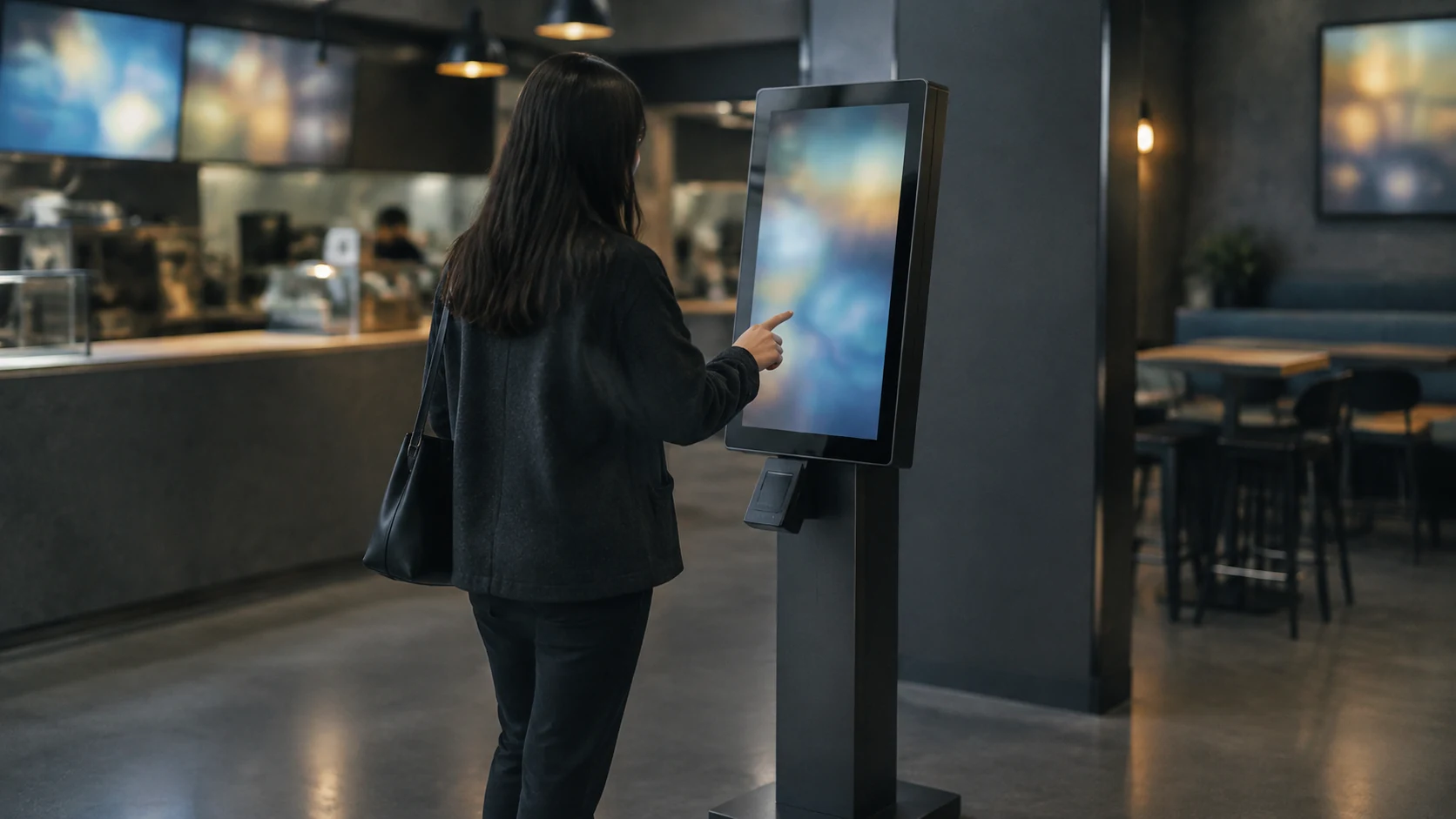
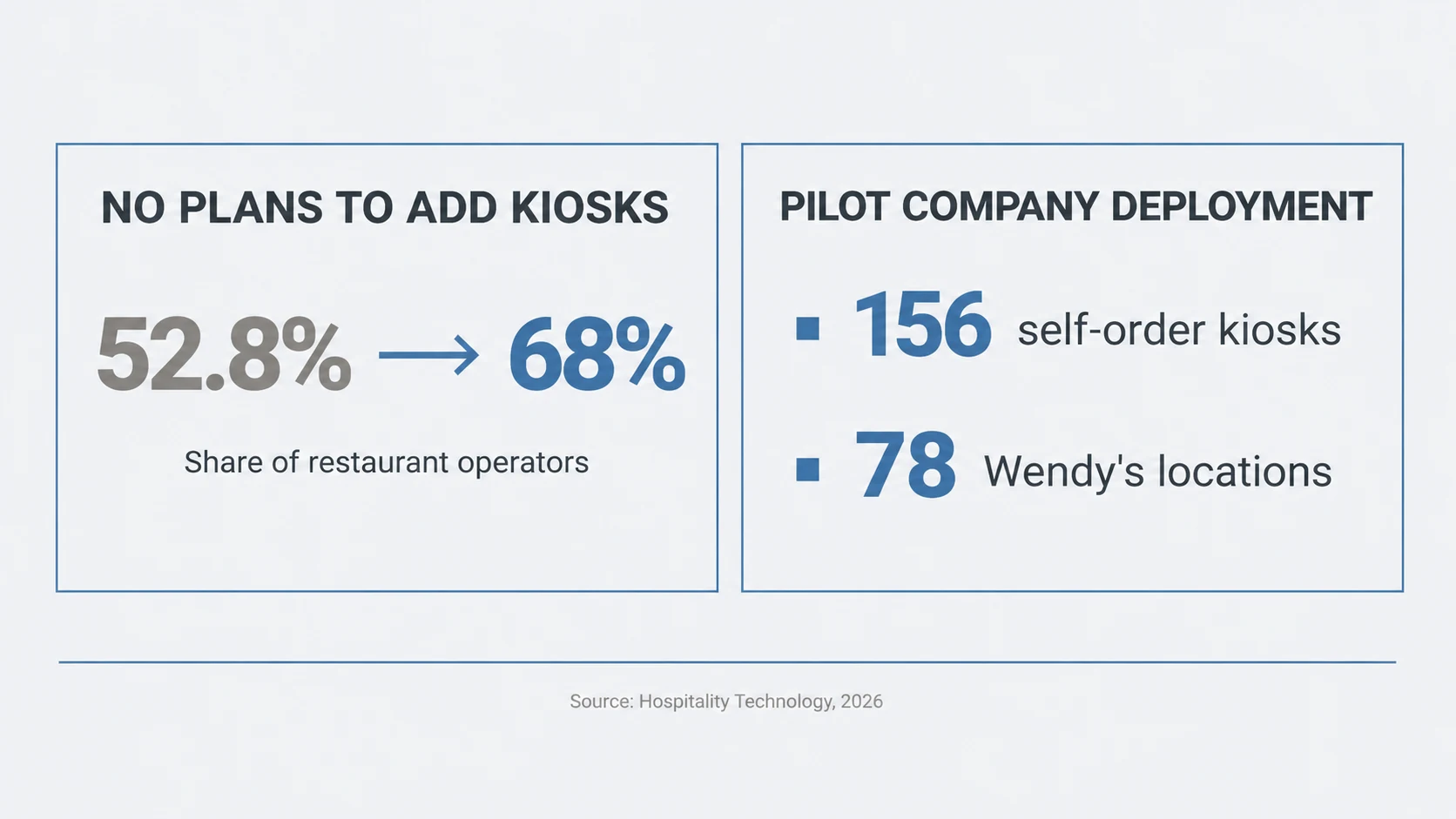
On September 9, Hospitality Technology reported that Pilot Company is installing 156 self-order kiosks across 78 Wendy's locations inside its North American travel centers. Pilot is a franchisee of several major quick-service brands, including Arby's and Subway, and the kiosks arrive as part of a broader set of digital initiatives.
Published in the same article was a number that appears to point the other way. In Hospitality Technology's 2026 Restaurant Technology Study, the share of restaurant operators reporting no plans to add kiosks rose from 52.8% to 68%.
Those two facts are easy to read as a contradiction — one operator scaling up while two-thirds of the field steps back. The reconciliation is where the useful information sits, and it has more to do with hardware than with sentiment.
A finished rollout is not a lost market
Hospitality Technology's own interpretation is that the 68% figure reflects the shape of an adoption curve rather than a collapse in appetite. After five years of aggressive post-pandemic deployment, many large chains have finished building out their kiosk footprint. They report no plans to add kiosks because the screens are already standing in their dining rooms.
One caveat belongs on that number before anyone builds a forecast on it. The 68% comes from a single publication's own operator study, and the report as published does not disclose its sample size. It is a directional signal from one source, not an industry census.
Taken as a directional signal, it still describes a change of order pattern that any equipment supplier will eventually feel. A chain in rollout mode buys in fleets: hundreds of identical units, one specification, one deployment window. A chain that has finished buys replacements — for units that failed, units that aged out, sites that were remodelled, payment modules that lost certification. Individually those orders are small. Collectively they are less forgiving, because a replacement has to fit a counter cutout, a mount, and a peripheral set that were fixed three or four years earlier.
Where the screen belongs becomes part of the specification
The guest-side data in the same reporting explains why deployment has turned selective rather than universal. Hospitality Technology's forthcoming 2026 Guest Engagement Study found 57% of diners satisfied with self-ordering technology against 14% dissatisfied, and 45% saying kiosks make overall service feel more efficient. It also found 27% saying kiosks can make an experience feel impersonal.
That 27% is not a defect to be engineered away. It is a description of where kiosks do and do not belong. Hospitality Technology draws the line plainly: in a sit-down bistro or a community cafe, lost human warmth can damage guest loyalty, while in a travel plaza off the Interstate a customised order without a counter queue is precisely what good hospitality means there. Travel centers sit at the far end of the convenience spectrum — drivers stopping for fuel, coffee, or a fast meal want their food quickly.
For a manufacturer that means the addressable market fragments by environment rather than by brand. The same operator may want kiosks in one format and refuse them in another, and both decisions can be correct.
The labour driver is the durable one
Two demand drivers show up in this data, and they have different half-lives. Novelty fades. Staffing economics do not. The Guest Engagement Study reports that 25% of consumers are more open to self-service technology than ever before, specifically because it offsets short-staffed counters and long wait times.
Acceptance grounded in that reasoning tends to persist. It is also the driver least sensitive to whether a chain has already completed a rollout, because it applies per site and per shift rather than per programme.
What a replacement market asks of the hardware
A market past its deployment peak rewards different supplier behaviour than a market in rollout. Mechanical continuity matters more than feature velocity: the same bezel dimensions, the same pedestal or wall interface, the same printer and scanner cutouts, still available years after the original order. So does the ability to change one subsystem without redesigning the enclosure, because payment hardware runs on a certification clock that the rest of the unit does not share.
Serviceability moves up the list as well. A kiosk in a travel center has no IT team standing behind it, and a unit that has to be shipped back is a unit out of revenue for a week.
Reading the number correctly
We build POS touch systems alongside industrial panel PCs, box PCs, and Android all-in-ones, and those four families share most of their mechanical and thermal engineering. That structure exists because catalogue longevity is a commercial requirement rather than a marketing claim — the customer most likely to call is the one who bought in 2022 and needs something that drops into the same hole.
The 68% figure will be quoted as evidence that kiosk demand has stalled. Read alongside 156 units going into 78 travel-center restaurants, the more careful conclusion is that the volume phase has ended in the segments that adopted first, and the demand that remains is far more specific about where it goes and what it has to fit.