

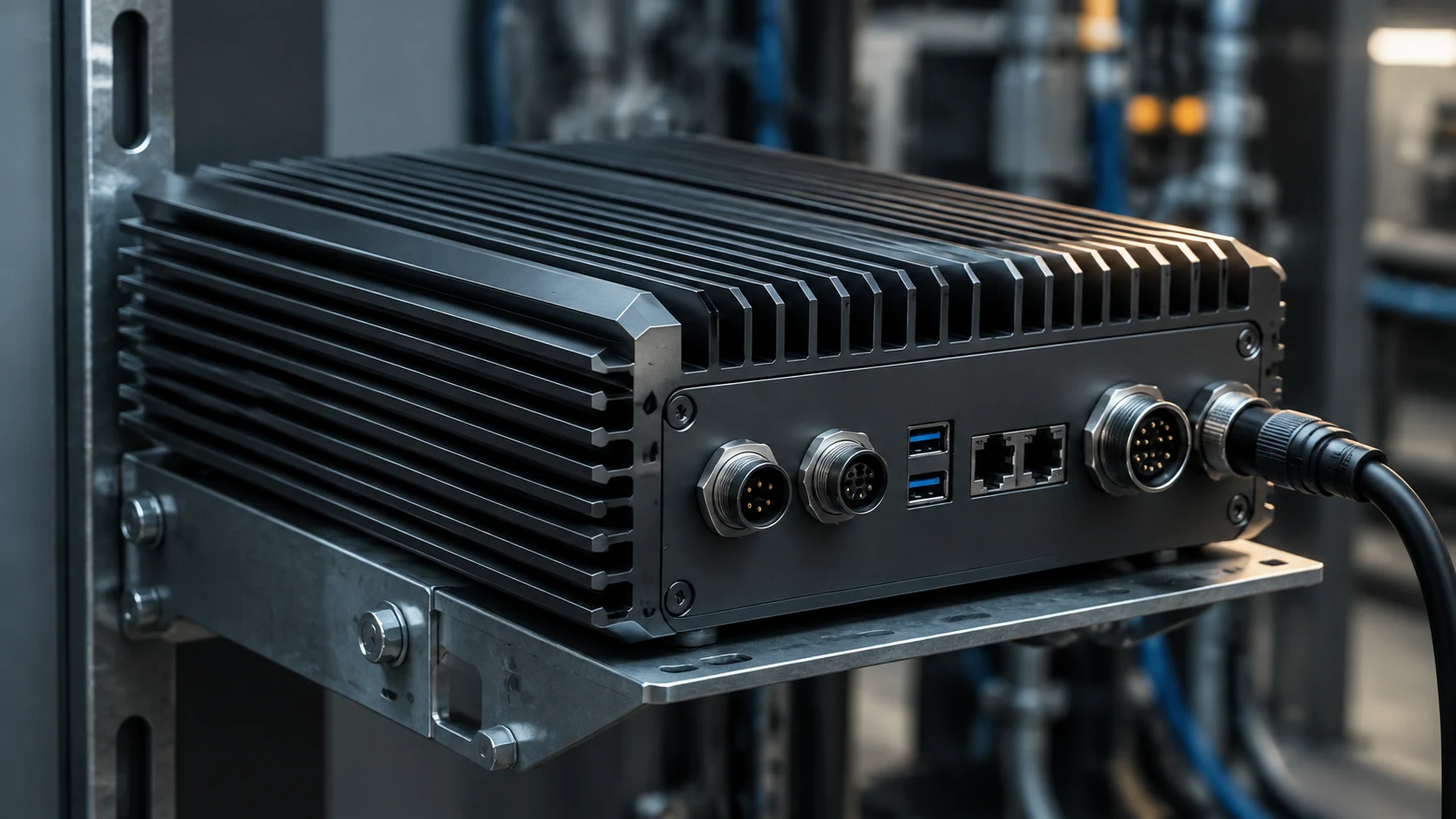
On September 15, ResearchAndMarkets.com added a study of the global ruggedized embedded system market to its catalogue, projecting a compound annual growth rate of 10.6% from 2026 through 2034. The drivers it names are the expected ones: defense and aerospace modernisation, industrial automation, railway and intelligent transportation programmes, energy infrastructure upgrades, and remote asset monitoring.
Growth forecasts for rugged computing rarely surprise anyone who sells it. The section worth reading twice is the one on market challenges, because buried in it is the central engineering problem in this category — stated plainly, and without a solution attached.
A product that outlives its own component roadmap
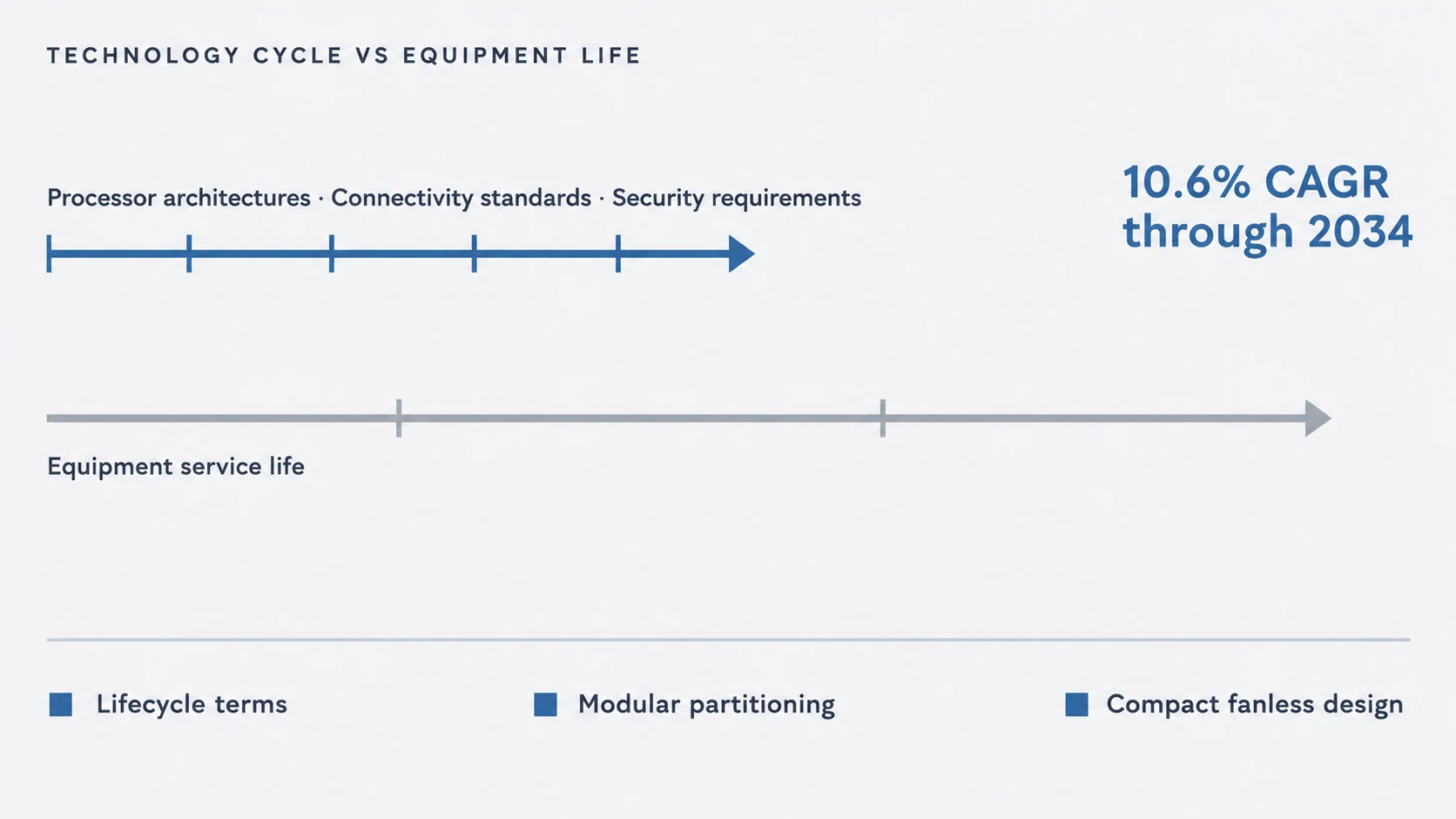
Among the factors the study says may limit adoption: rapid changes in processor architectures, connectivity standards, cybersecurity requirements and software platforms, which it notes may complicate upgrades for systems expected to remain operational for many years.
Read that against why rugged equipment gets specified at all. A controller in a substation, a display in a rail cab, a computer in a mining vehicle: these are bought because they are expected to stay in place for a decade, through weather, vibration and staff turnover. The purchase assumes stability. The silicon underneath assumes nothing of the kind.
The rest of the challenge list compounds it. Ruggedized systems, the study notes, frequently require advanced thermal management, mechanical reinforcement, electromagnetic interference shielding, sealed enclosures, shock protection and extensive certification testing, alongside high development costs, specialised engineering requirements and extended validation cycles. Each is a reason a finished design is expensive to reopen. The work that makes a rugged system rugged is the same work that makes it costly to change — precisely where the technology stack underneath demands change.
Which is why lifecycle terms became a competitive item
The study's assessment is that lifecycle stability remains a critical purchasing consideration, particularly in defense, rail, energy and public infrastructure programmes, and it names the components: extended availability, qualification support, validated reliability, repair services and multi-year maintenance. Its judgement is that these are becoming increasingly important competitive differentiators.
That is a claim about buying behaviour rather than technology. Two platforms with identical specifications are not equivalent if one carries a documented availability window and a repair path and the other does not. For a procurement team writing a ten-year programme, the second is a liability disguised as a saving.
Modularity is the structural answer, and it has a price
The study identifies modular and scalable designs as gaining momentum, because they let customers configure processing performance, environmental ratings, storage, input/output and communications interfaces across multiple applications, with common architectures reducing integration complexity.
Framed against the upgrade problem, modularity is not a convenience feature. It separates the parts of a system that turn over quickly — compute, radios, storage — from the parts that were expensive to certify and have no reason to change. Refresh the first without reopening the second, and a long-life product stops fighting its own component roadmap.
The cost is that the boundary must be chosen early, before anyone knows which interface will move next. Partition it well and a compute refresh leaves the enclosure, thermal solution and EMC evidence untouched. Partition it badly and you have paid for modularity in connector count and internal volume while still facing full requalification. That boundary is one of the more consequential calls in a platform design, and not one a market forecast can help with.
Fanless, compact, and warmer every generation
Two further trends in the study sit awkwardly together. Compact fanless rugged computers are seeing increased demand in vehicles, mobile platforms, industrial cabinets and outdoor control installations, with suppliers working on thermal efficiency and compute density while reducing size and maintenance requirements. Meanwhile edge AI is named as an important growth area, with rugged platforms increasingly supporting computer vision, autonomous navigation, sensor fusion, anomaly detection and industrial inspection — pushing designs toward GPU acceleration and higher local processing.
Those two pull against each other inside the same enclosure. Every watt of added inference performance is a watt a sealed, fanless chassis must move through its own casting. And the reason fanless is wanted in the first place — no moving parts, no filters, no service visit for a seized bearing — is the reason the thermal budget cannot simply be raised. Compute density here is a heat transfer problem long before it is a silicon selection problem.
How this reads from the manufacturing side
On segmentation, the study finds rugged panel PCs and HMIs account for a significant share of the market, attributing it to their use across industrial automation, transportation control, field diagnostics, energy infrastructure and operator interfaces. Regionally it places North America largest, on defense spending and established automation infrastructure, with Asia Pacific growing fastest and Europe holding position through rail, defence electronics and smart manufacturing.
Yinestar builds industrial panel PCs, box PCs, Android all-in-ones and POS touch systems, and for us the forecast headline is the least actionable part of this study. The constraint list maps onto real decisions: how far a platform can be partitioned so a processor generation change does not restart certification, how much thermal headroom to design in for inference workloads no customer has asked for yet, and what availability window can be committed to honestly. A 10.6% growth rate says the demand will be there. It says nothing about whether a given platform will still be supportable when it arrives.