

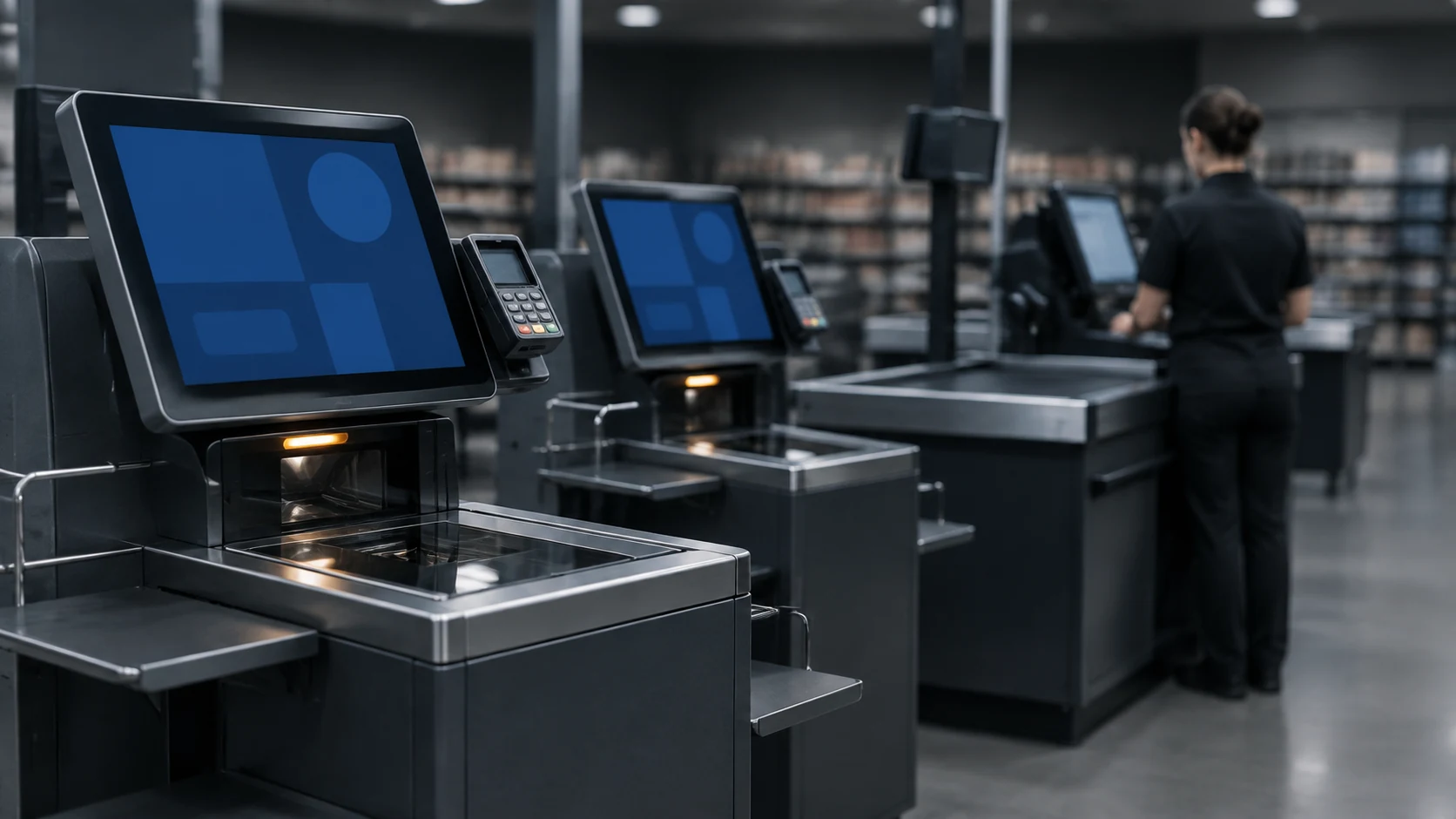
Rhode Island Senate Bill 2342 and its companion House Bill 7290 were signed on June 18. From January 1, 2027, covered grocery stores must provide one staffed checkout for every three self-checkout stations running simultaneously, and may not operate more than eight at once. Employees assigned to monitor the self-service area must be relieved of other duties while doing so, including operating a manual register. The law carries accessibility provisions and fines.
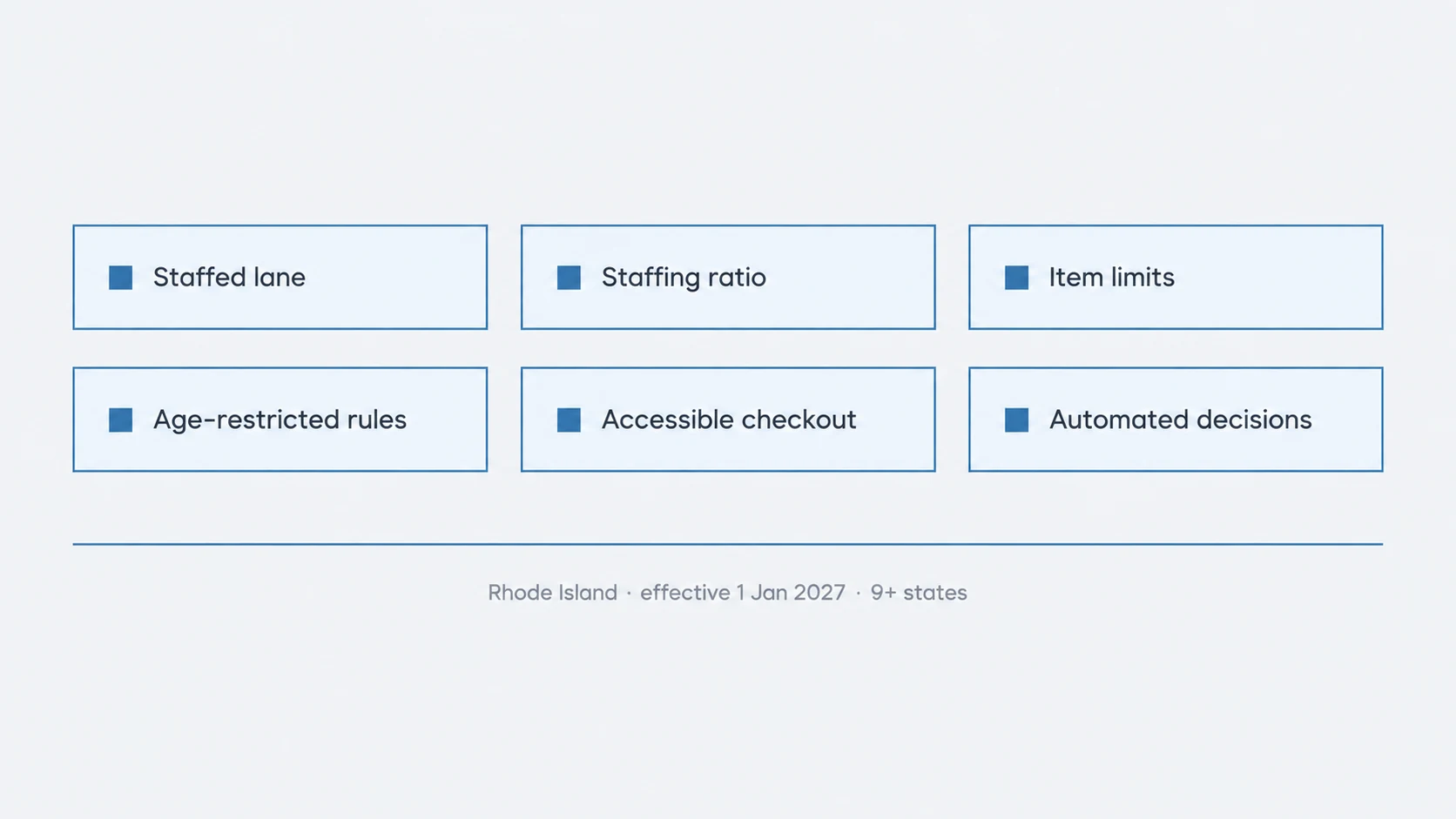
Reporting on August 4 placed that law in a wider picture: legislative efforts have surfaced in at least nine states, and self-checkout has stopped being treated purely as a business decision. Rhode Island matters because it gives other legislatures a working model rather than a concept. For anyone who builds self-service terminals, though, the pattern across the bills is that they regulate the same six things and pick different numbers for each.
Same controls, different constants
Count the ratios. Rhode Island requires one staffed checkout per three simultaneous self-checkouts; Ohio Senate Bill 415 would assign one employee per three, and New York City is weighing the same ratio. Connecticut Senate Bill 438 would have required one monitoring employee per two; it died when the 2026 session ended.
Count the caps and item limits. Rhode Island sets eight machines running at once; Connecticut proposed eight; Massachusetts Senate Bill 237 would set a similar eight-kiosk cap with staffing requirements, having drawn a favourable committee report and gone to Senate Ways and Means in December 2025. California Senate Bill 442 would require a posted 15-item limit plus an available staffed lane, a dedicated self-checkout monitor and advance notice before a retailer introduces new checkout technology; it passed the Senate in 2025 and remains pending in the Assembly Appropriations Committee after an August 2025 hearing was postponed. Ohio's bill posts a 15-item limit, as does the New York City proposal.
The merchandise rules are categorical rather than numeric. Ohio's bill would bar using the machines for alcohol, tobacco and products protected by theft-deterrent devices. Maryland House Bill 1213 would have barred certain alcohol retailers from self-checkout entirely; it did not advance in 2025. Washington House Bill 1739 and Tennessee Senate Bill 2001 vary the same themes, and three California cities — Long Beach, Costa Mesa and Santa Ana — have adopted ordinances with staffing and transaction requirements.
Which makes it a configuration problem, not a product problem
A vendor could treat each jurisdiction as a variant. That is the expensive answer, and it worsens every session, because a bill that dies this year returns amended with a different constant. The cheaper answer is that each of these values is a setting: item ceiling, permitted product classes, active-station count, attendant-to-station ratio, the notice shown before a transaction. The reporting reaches a similar conclusion, noting that compliance capabilities could become a competitive feature and listing configurable item limits, clearer attendant alerts, accessible interfaces, transaction restrictions, staffing dashboards and auditable records of AI-generated interventions. We would put it differently: the competitive feature is not compliance with a particular statute, it is satisfying a new one without a firmware release.
One clause deserves separate attention. Rhode Island's requirement that a monitoring employee be relieved of other duties reads as pure headcount, but if one person is accountable for a bank of machines and cannot be pulled to a register, how they learn a machine needs attention becomes load-bearing. Attendant alerting used to be a convenience feature; under a staffing rule with fines attached, it is how the store shows the arrangement works.
Auditable records turn the terminal into an evidence source
The most demanding item on that list is the last. Loss prevention has driven vendors to add computer vision, item recognition, weight validation and artificial intelligence meant to spot missed scans or product switching — systems that raise questions about privacy, bias, data retention and false accusations. The reporting records the view that vendors who disclose error rates, limit retention and require human review before stopping or accusing a shopper can more easily argue their systems protect customers rather than surveil them, and that retailers should publish error rates, employee interventions, accessibility performance and wait times.
Each of those is a data requirement before it is a policy position. Publishing an intervention rate means the terminal logged interventions in a form someone can total. Requiring human review means it recorded which human reviewed what, and when. Limiting retention means deletion is scheduled rather than aspirational. That is logging, retention and access control on a device specified to move a queue.
How we read it
The union that backed the Rhode Island law framed the staffing requirement as both a labour and a consumer-protection measure, arguing the technology shifts work to customers while cutting employees' hours. The reporting also records the counter-argument that staffing mandates and price controls risk preserving an older operating model, and that complex rules weigh more heavily on independent retailers than on chains with compliance staff. Both arrive at the same outcome for equipment: the machine has to prove how it behaved.
Yinestar builds POS touch systems, Android all-in-ones, industrial panel PCs and box PCs. New York's separate proposal — Assembly Bill 11501, introduced May 28 and still in the Assembly Consumer Affairs and Protection Committee as of August 3, which would cut prices 10% on goods bought through self-checkout — may go nowhere. Rhode Island already passed. The question is not which bill survives, but whether a terminal's settings absorb whichever one lands.